
On the morning of August 24, Liu Lijia, Director of the Social Education Department and Guide at the Shijingshan District Museum of Beijing, accepted the invitation of the lecturers of "Badachu Legends" (a national intangible cultural heritage representative project). Stepping out of the museum, she went to the base of the Liao Dynasty Tooth Relic Pagoda of the Buddha at Lingguang Temple, where she told the lecturers and tourists about the twists and turns in the circulation history of the Buddha's Tooth Relic at different stages.
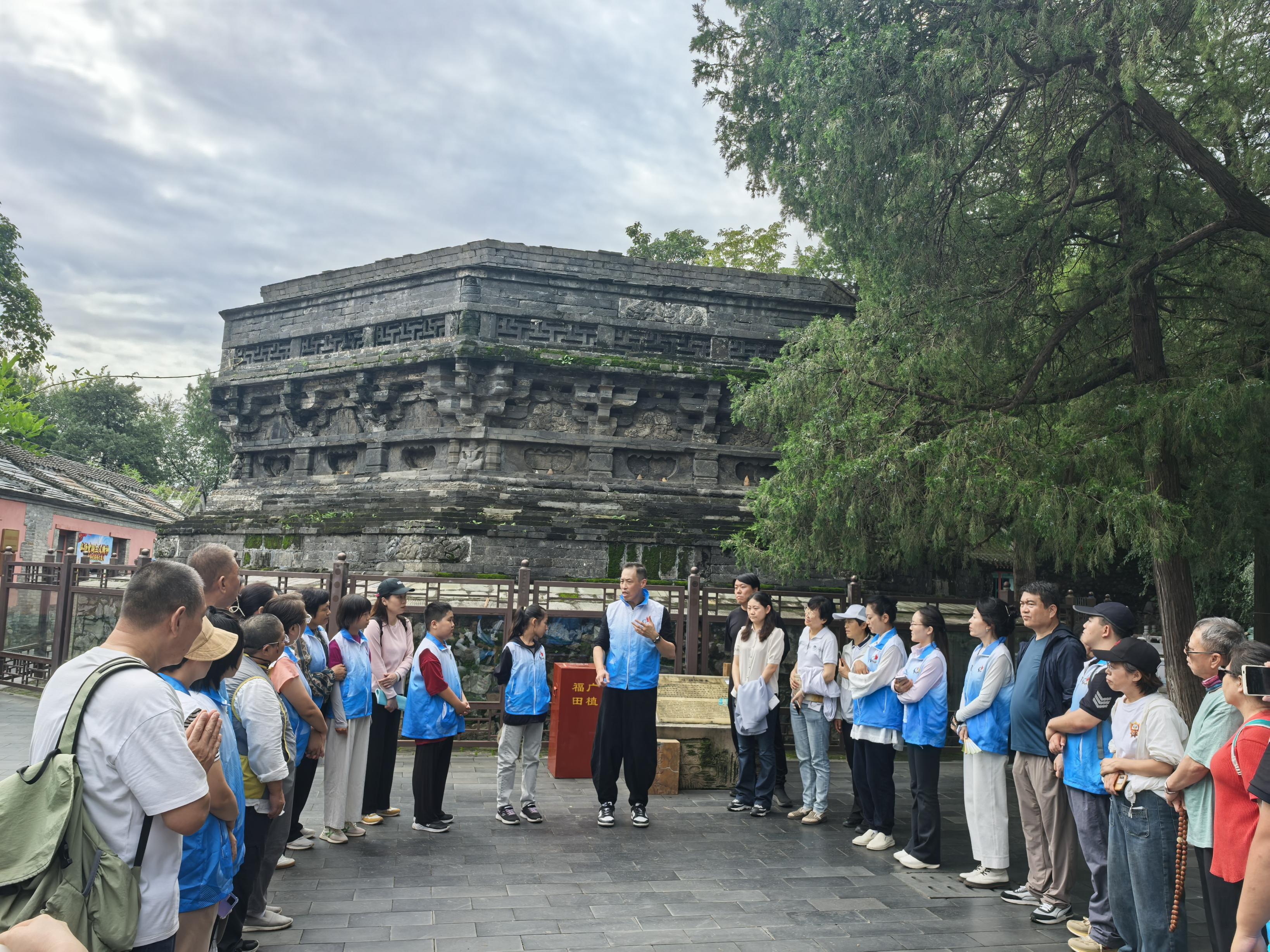
Liu Lijia, Guide at the Shijingshan District Museum of Beijing, Narrates the Legend of the Buddha's Tooth Relic Pagoda
Folk legends are mostly closely attached to local mountains, rivers, buildings, and landscapes. Liu Lijia stated that Badachu, as an important imperial ancient building complex in the Western Hills of Beijing, is not only a cultural relics resort in Beijing but also in the whole country, with many precious cultural relics preserved. In addition to the Buddha's Tooth Relic at Lingguang Temple (the 2nd site of Badachu), there is also the Stone Tablet of the Great Compassion Bodhisattva's Self-Portrait at Xiangjie Temple (the 6th site). On the reverse side of the tablet are the two characters "Respect the Buddha" written in regular script by Emperor Kangxi in his own handwriting, which echoes the Hanbaiyu (white marble) tablet of Emperor Kangxi's "Imperial Inscription for Shenganying Temple". It is said that the Eighteen Arhats at Dabei Temple are also exquisite carvings handed down from the Yuan Dynasty. Each of these physical relics is accompanied by wonderful legends.
As early as October 28, 1958, Badachu in the Western Hills was included in the first batch of municipal-level cultural relics protection units announced by Beijing. Through Liu Lijia's introduction, the lecturers gained a deeper understanding of Badachu as a "naturally-formed, rich and colorful museum", including the "Cheng Guan Wan You" (literally meaning "Contemplating All Things") plaque with colored lacquer and blue characters inside Xiangjie Temple during the Qianlong reign (recorded in Volume 11 of Compilation of Historical Materials from the Workshop of the Yangxin Hall), as well as numerous stone carvings and buildings.
Community Resident Qu Ziyang Tells the Story of "Fish Turning into a Dragon" at the Goldfish Pond
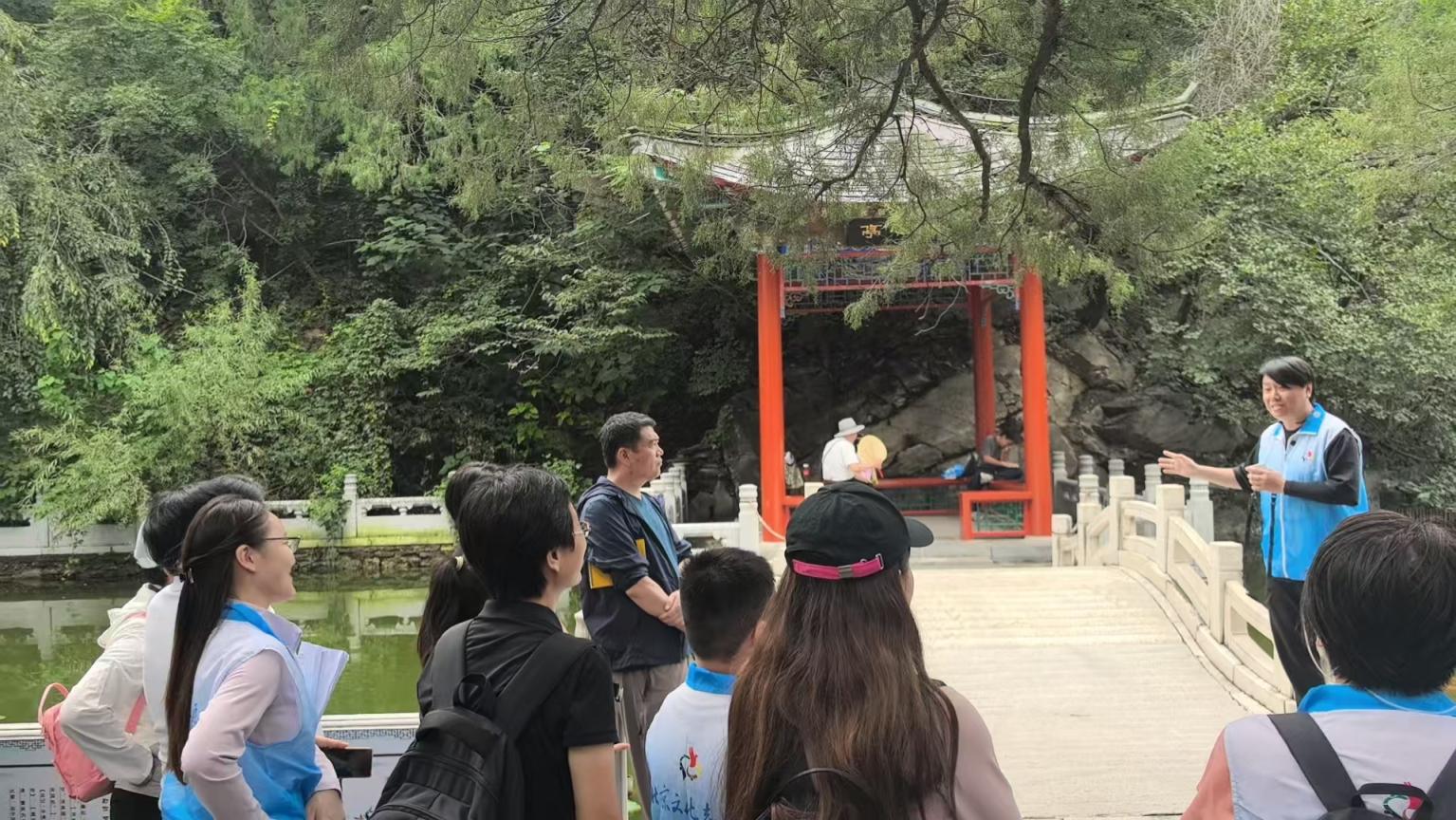
By the Goldfish Pond at Lingguang Temple, Liu Lijia exchanged ideas with more than a dozen volunteers, including Qu Ziyang (a cultural volunteer who told the story Fish Turning into a Dragon), Guo Xiaolu (a student from Shougang Technician College who narrated the story Empress Dowager Cixi and the Goldfish Pond), and Liu Yisong (a student from Beijing Huangzhuang Vocational High School). The charm of folk literature has attracted these community residents and college students to participate. Especially by the Qinglong Pond at the 8th site, Liu Lijia guided primary school students Ge Xin and Yang Mingyue (who told the story Inspiration and Universal Salvation) on the skills of narrating legends. More than twenty lecturers exchanged views with her, putting forward various questions for discussion, and the atmosphere was lively.
The person in charge of intangible cultural heritage at the Badachu Park Management Office also attended the event. She warmly encouraged cultural volunteers from all districts and counties in Beijing to practice and spread the culture of the Western Hills and Yongding He (River). She also sincerely invited more museum volunteers to come to Badachu to jointly inherit the cultural context and pass on the ancient folk legends, ensuring that the excellent Chinese culture endures for generations.
Translator: KAN Bowen
Reviewer: ZHANG Xinni


