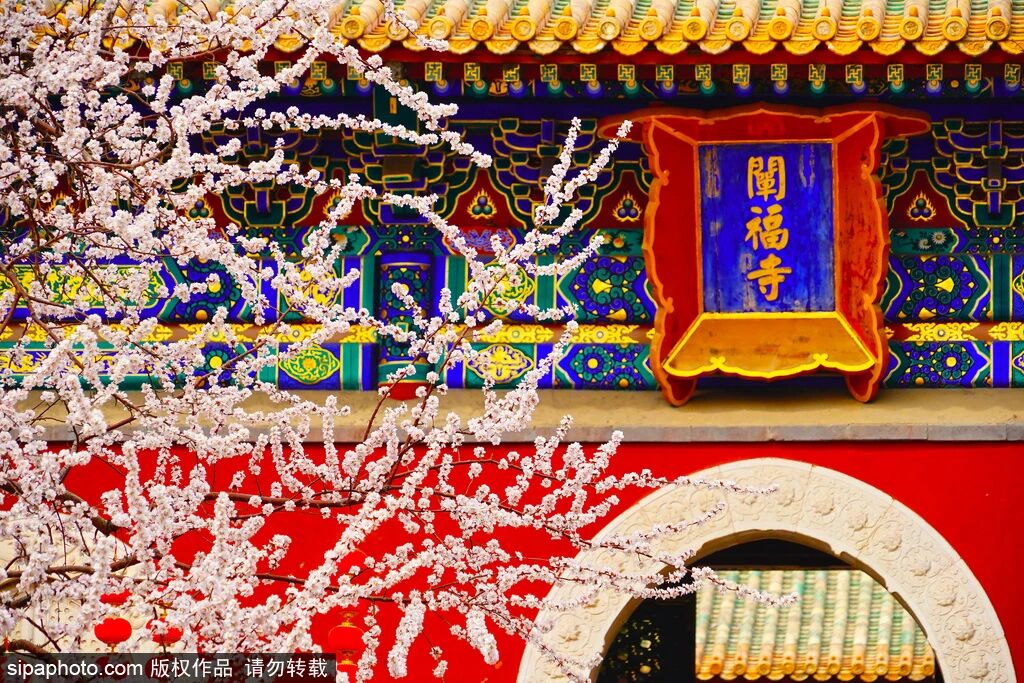
Lama Temple
Lama Temple is the largest Tibetan Buddhist temple in Beijing, known for its grand scale, historical significance as a religious site for Qing emperors and their connections with the upper class of Mongolia and Tibet. The original site was built during the Kangxi reign of the Qing Dynasty as the mansion of Yinzhen, the fourth son of the emperor. After Yongzheng's death, Qianlong converted the mansion into a Tibetan Buddhist temple.

Lama Temple is one of the most famous Tibetan Buddhist temples in China and abroad. The temple is located in the northeast corner of the inner city of Beijing, stretching from Xilou Hutong in the south to the inner city wall in the north, with a total length of nearly 400 meters and an area of over 66,000 square meters. The halls are magnificent and majestic, and it is the most popular and effective place for folk legends and prayers.
Lama Temple is divided into three routes: east, middle, and west. The middle route is the main visiting route, consisting of five courtyards and five-story halls, as well as east and west side halls and the "Sixue Hall". Visitors can walk along the central axis to explore the temple.

There are three circulation areas in Lama Temple. One is located next to the entrance and does not require a ticket to buy Buddhist items. The other two are located next to the incense giving area of Zhaotai Gate and the consecration area respectively.
There are many other tourist attractions near Lama Temple, such as Nanluogu Xiang, Shichahai, and Jingshan Park, which can be arranged for a day trip. There is also a commercial street called Yonghe Dajie (St) near Lama Temple, where you can find many local snacks, handicrafts, and souvenirs.

Each hall in Lama Temple has a different function to meet people's different wishes. Yonghe Gate prays for happiness and smoothness in life; Yonghe Hall focuses on seeking wealth and prosperity; Yongyou Hall drives away evil and disasters, and blesses family members with peace and health; Falun Hall wishes for success in career and smooth progress in the workplace; Wanfu Pavilion prays for peace and good luck; Guanyin Pavilion is for finding a good marriage partner; Suicheng Hall wishes for good luck and success; Mizong Hall is for joy and peace; Yaoshi Hall drives away diseases and seeks health; East Side Hall is for seeking wealth and prosperity; Jingjing Hall is for peace and health; Shilun Hall is for turning the world around; West Side Hall is for academic success and passing the imperial examination.
It takes 2-3 hours to visit Lama Temple.
Opening hours: 9:00-17:00, with last admission at 16:30
Note: During national holidays, weekends, and the 1st and 15th of the lunar calendar, the opening time is 8:40, and on weekdays it is 9:00.
Address: No. 12 Yonghegong Dajie (St), Dongcheng, Beijing
Hongluo Temple
Hongluo Temple is a sacred site of Buddhism throughout the ages and the birthplace of Jinghua Qigong. It was first built in the Eastern Jin Dynasty as a ten-directional permanent temple and has been the largest Buddhist forest in the north for thousands of years. Many of the abbots were appointed by the royal family, and many eminent monks emerged. It is said that "there is Putuo in the south and Hongluo in the north". The environment inside the temple is elegant, with ancient trees towering into the sky and evergreen all year round. The Wisteria on the Pine, the Imperial Bamboo Forest, and the Male and Female Ginkgo Trees are known as the three unique landscapes.

Hongluo Temple is a famous ancient Buddhist temple both at home and abroad, and also the most prosperous royal temple in Beijing. It is very effective in seeking marriage. The temple has a history of more than 1,600 years, with a profound Buddhist cultural heritage. The temple is surrounded by mountains and rivers, hidden in the forest, and has a profound artistic conception. There is a saying among the people that "men go to Lama Temple and women go to Hongluo Temple", meaning that men pray for blessings at Lama Temple and women pray for blessings at Hongluo Temple.

For a long time, many people who come to Hongluo Temple to pray for blessings are seeking good health. If you want to have a child, you should go to the Guanyin Temple after worshiping the main hall. Although the road is steep, you must climb to the top of the mountain with sincerity to receive the blessing of the Bodhisattva. The Manjusri Bodhisattva in Hongluo Temple can help with academic studies.
Address: No. 2 Hongluo Donglu (Rd), Huairou, Beijing
Tanzhe Temple
Tanzhe Temple is located at the foot of Tanzhe Mountain in the southeast of Mentougou, Beijing, more than 30 kilometers away from the city center. The temple faces north and backs against Baozhu Peak. The temple covers an area of 2.5 hectares, and the surrounding forest and mountain fields under the jurisdiction of Tanzhe Temple cover a total area of more than 121 hectares.

Tanzhe Temple was first built in the first year of the Yongjia period of the Western Jin Dynasty (307 AD). The temple was originally named "Jiafu Temple" and was the earliest temple built after Buddhism was introduced to Beijing. Emperor Kangxi of the Qing Dynasty named it "Xiu Yun Temple", but because there is a dragon pond behind the temple and a tea tree on the mountain, it has been called "Tanzhe Temple" by the people. Because of its long history, there is a saying among the people that "Tanzhe Temple came first, and then Beijing City".

Tanzhe Temple has a total of 943 rooms, including 638 ancient buildings, which maintain the style of the Ming and Qing Dynasties. It is the largest ancient temple complex in the suburbs of Beijing. The entire complex fully embodies the aesthetic principles of ancient Chinese architecture, with a central axis running through it, and the left and right sides are basically symmetrical, making the entire complex appear orderly, strict, clear in hierarchy, and clear in layers.
Due to its long history, Tanze Temple has many ancient trees. The most famous among them are the two "millennial cypresses" planted during the Liao Dynasty in the abbot's courtyard. They are both over 30 meters tall, towering into the sky and reaching the highest among ancient cypresses in the Beijing area. It is said that the enlightened monk who achieved immortality in the temple ascended to heaven from these trees, hence their name "Heavenly Ascending Cypresses".

During the Chinese New Year, Tanzhe Temple is crowded with visitors starting from the twelfth lunar month. During the Laba Festival, the temple distributes porridge, which is famous throughout the world due to the "treasure pot" in the temple. People come in a continuous stream to drink the porridge. The "Welcoming Spring and Praying for Blessings" ceremony during the Spring Festival is also a major attraction.
Address: Tanzhe Temple Town, Mentougou, Beijing