Following the exhibitions on Dunhuang and the Silk Road, Beijing Minsheng Art Museum recently launched a major exhibition titled "The Origin of Civilization: A Grand Exhibition of Early Chinese Civilization," taking visitors on a one-stop journey through thirteen major cultural sites such as Yangshao, Hongshan, Liangzhu, Erlitou, Yinxu, and Sanxingdui, sparking a wave of "check-ins."
Unlike cultural exhibitions in museums, the art museum's cultural exhibition focuses more on an "exploration" experience. The exhibition hall not only features heavyweight cultural relics but also includes multiple large-scale art installations to stimulate tangible imagination, and utilizes modern technology and AI interaction to make the early Chinese civilization, which slumbers in archaeological materials, visible, tangible, and playable.
Visible: Pre-Qin civilization proven by archaeology
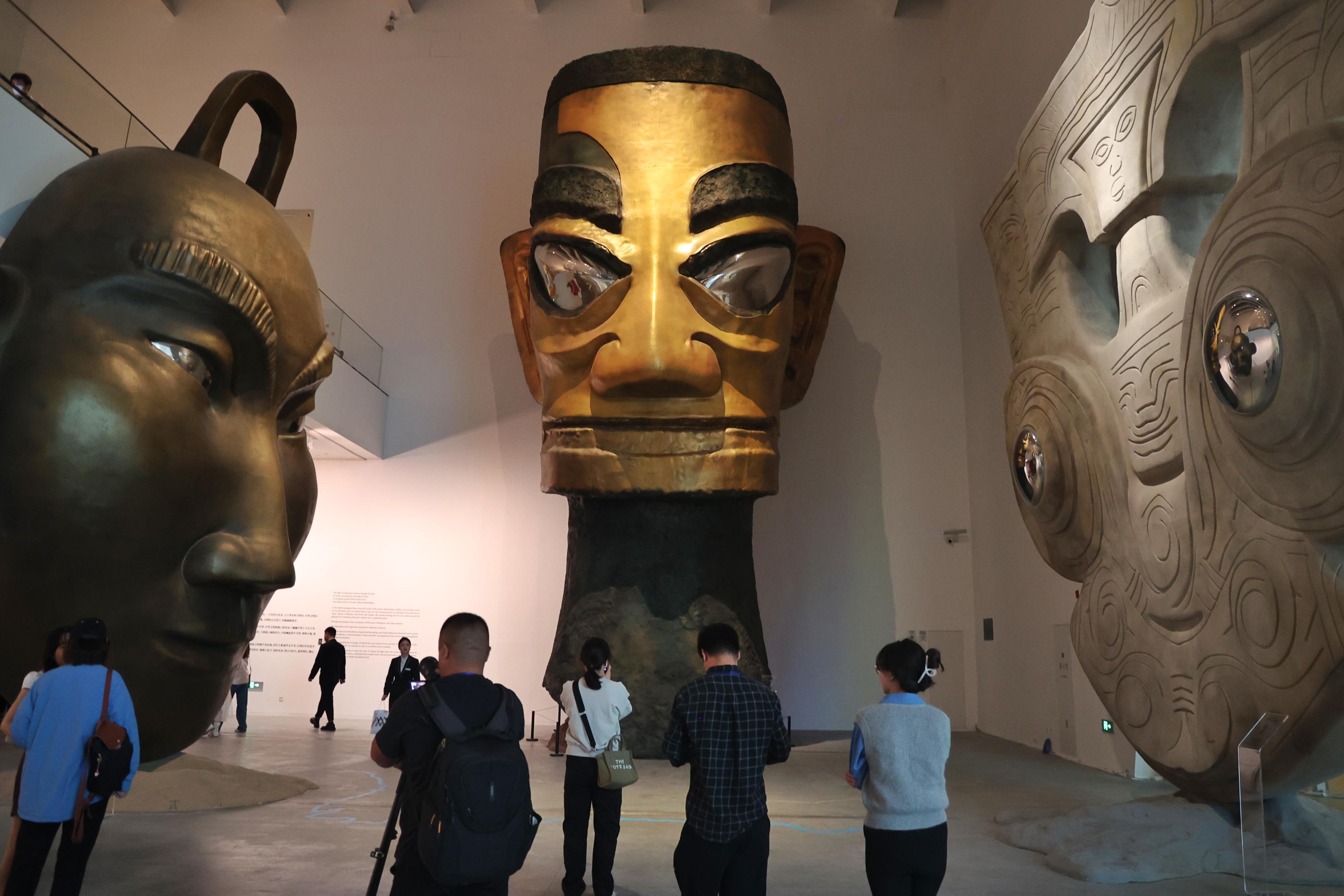
Entering the exhibition hall, under the gaze of three huge masks representing Liangzhu, Yinxu, and Sanxingdui ancestors, visitors can't help but feel a sense of pride. The history of Chinese civilization in the pre-Qin era is not just myths and legends, the Three Sovereigns and Five Legends recorded in ancient books, but is revealed, restored, and proven step by step through archaeology, supplemented by field excavations. The art museum designed the eye parts of the three ancestors' masks as reflective mirrors, and when visitors look at them, they can see themselves in their eyes, as if standing in the ever-flowing historical space at the same time, and their gaze leads visitors to the civilization sites of Liangzhu's Waterborne Kingdom, Yinxu's Bronze Age, and Sanxingdui's star-studded divine country.
This exhibition is divided according to the chronological thread of the origins of early Chinese civilization, designed in a "3+1" manner. The three chapters are "All Under Heaven, Starlight of Civilization," focusing on the ancient period, explaining the inevitable process of transition from primitive society to the state form; "All Nations Converge, Ancient Nations Standing," describing the overall stage from natural communities to ancient nations standing; "Dwelling in China, the Rise of Dynasties," outlining the pluralistic and unified civilization path of the ancient country era, laying the foundation for the unified empire era of the Qin and Han dynasties. The last special chapter, "The Luster of Ancient Shu," is a special chapter set up in memory of the 90th anniversary of the official excavation of Sanxingdui.
Tangible: Qianlong's arbitrary interpretation, restoration of sanxingdui sacrificial scene
Archaeological excavations have confirmed that the Liangzhu civilization has formed a complete set of jade ritual system, which is regarded as one of the sources of the ritual expression of Chinese civilization. Among them, the important ritual object, the jade cong, gradually lost its original function after the Zhou Dynasty and was not recognized by people. Interestingly, there is a Liangzhu jade cong in the exhibition that was once modified by Emperor Qianlong of the Qing Dynasty.
Qianlong matched the jade cong with Fetal copper filigree ename gallbladder, modified it for use as incense, and engraved his own imperial poems on the outer wall of the jade cong. Modern archaeologists infer from the content of the poems and the direction of the carving, which is upside down with the decoration of jade cong, that Qianlong may not have known the origin and former use of this object.
Around this ritual object, the exhibition displays the jade nine-section human face pattern cong cultural relics of Liangzhu culture period and a Longquan kiln green glaze cong-shaped bottle that circulated in the Southern Song Dynasty side by side, spanning 3,000-4,000 years. Although the materials and functions of the objects have changed greatly, their posture and shapes remain highly similar, which is enough to see that the inheritance of Chinese early civilization elements has never been interrupted.
In the Sanxingdui special exhibition area, a tall bronze divine tree is quite eye-catching. The branches are divided into three layers, with three branches on each layer. On one side of the branch head is a standing bird, and on the other side is a dragon crawling down from top to bottom and attached to the trunk. This bronze divine tree is a replica, and the original was unearthed in 1986, reaching a height of 3.96 meters, making it the tallest bronze ware in the world at the same period. Although it is a cultural relic replica, it presents a restored scene of the sacrificial activities of the Sanxingdui ancestors here, along with other bronze wares, animal masks, and standing figures placed here.
Sacrifice occupies an important position in Sanxingdui society and is the most important aspect to understand Sanxingdui culture. The many cultural relics unearthed now, including gold wares, bronze wares, jade wares, ivory, etc., are likely to be related to sacrificial objects. The following question is, how were they used? To give visitors a more realistic experience, the exhibition restores a conjecture plan by Mr. Tang Jigen, the former head of the Anyang workstation of the Chinese Academy of Social Sciences Archaeological Research Institute. Although it is a personal opinion, it can also be regarded as a way to provoke thinking.
Playable: Design a bronze ware, AI makes it easy
"The Origin of Civilization: A Grand Exhibition of Early Chinese Civilization" displays more than 400 cultural relics, from more than 30 cultural and museum institutions across the country, including the Palace Museum, Shaanxi History Museum, Archaeology of Sichuan, Liangzhu Museum, Erlitou Site Museum of the Xia Capital, Yinxu Museum, Sanxingdui Museum, etc.
These pre-Qin era pottery, jade, bronze ware, and oracle bone script cultural relics may not be unfamiliar to visitors who like history, as they have been seen in many theme exhibitions in museums. The curatorial team of this exhibition said in an interview that in addition to systematically sorting out cultural relics according to the chronological context, as an art museum, they also hope to build an aesthetic field to help visitors open their imagination and perception of art during the exhibition. Therefore, they combine cultural relics exhibition with art installation, and the ancient civilization, empowered by art imagination and technology, brings more visual and sensory impact to visitors. For example, the Erlitou and Sanxingdui site sand tables restored with colored sugar beans and Lego components have attracted many children to stop, and each sugar bean is also painted with an oracle bone text, waiting for everyone to crack.
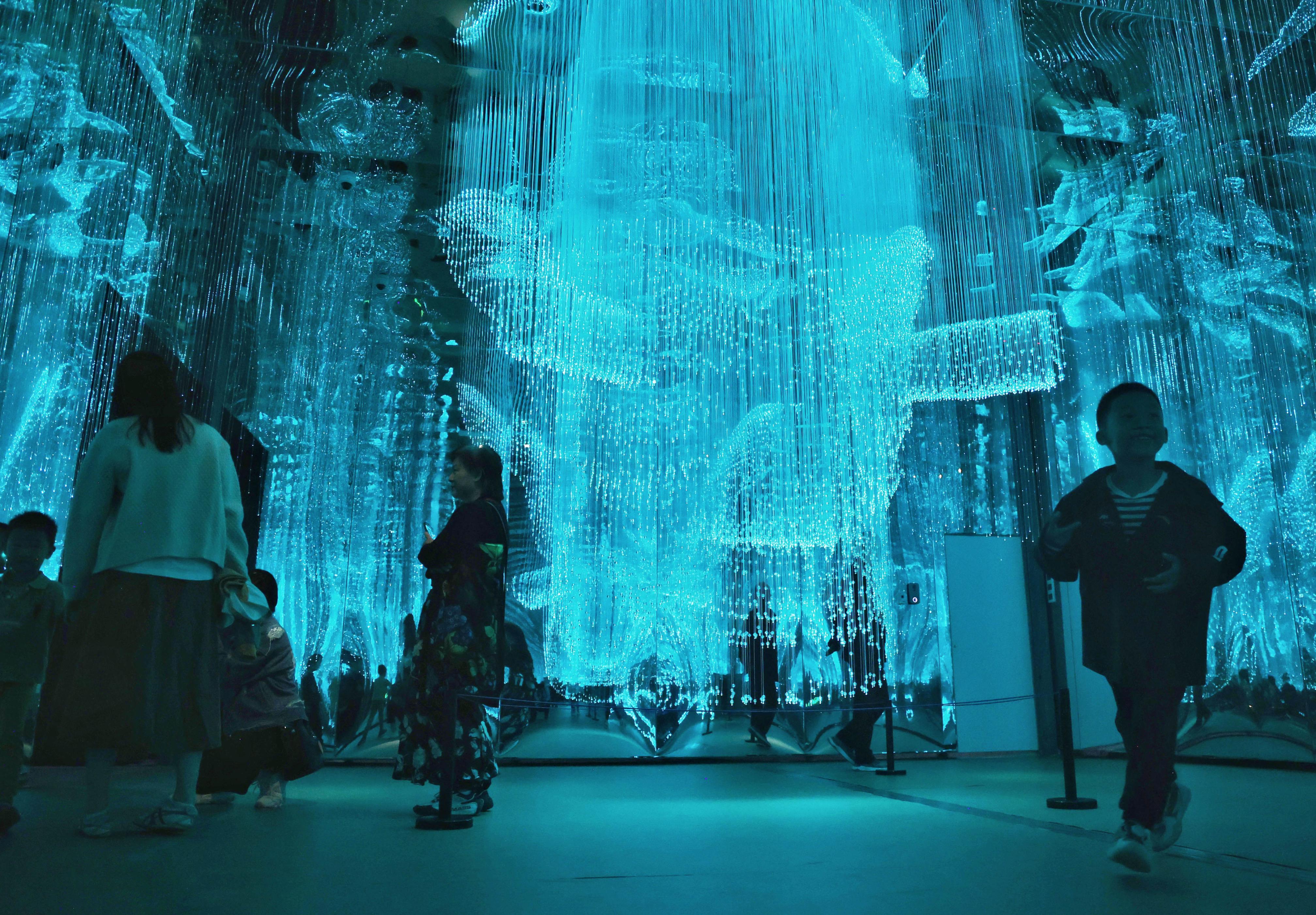
For example, the Sanxingdui independent space created with diode lighting, visitors take photos and check in it, as if immersed in a dream. A favorite interactive device for both young and old visitors is a row of touch screens at the entrance of the second-floor exhibition hall, which is a bronze sculpture drawing device presented with AI technology. Here, every visitor can become a master of bronze ware casting, just need to move their fingers and draw a small picture or a few lines on the screen, and AI can immediately present your creativity as a bronze ware, which can also be made into a mobile phone screen saver or printed and taken away.
The curatorial team said that these ingenious arrangements can stimulate more creativity among visitors. Innovatively integrating contemporary perspectives into the cultural relics exhibition and building a multi-dimensional dialogue between contemporary art forms and ancient civilization treasures is hoped to allow visitors to be in a unique "civilization site" and feel the different beauty of civilization integration and historical evolution.
During the exhibition, Beijing Minsheng Art Museum will also hold various types of public art education activities, including theme forums, academic lectures, youth research activities, and various art workshops, to increase the interest and interactivity of the exhibition. The exhibition will continue until March 31, 2025.