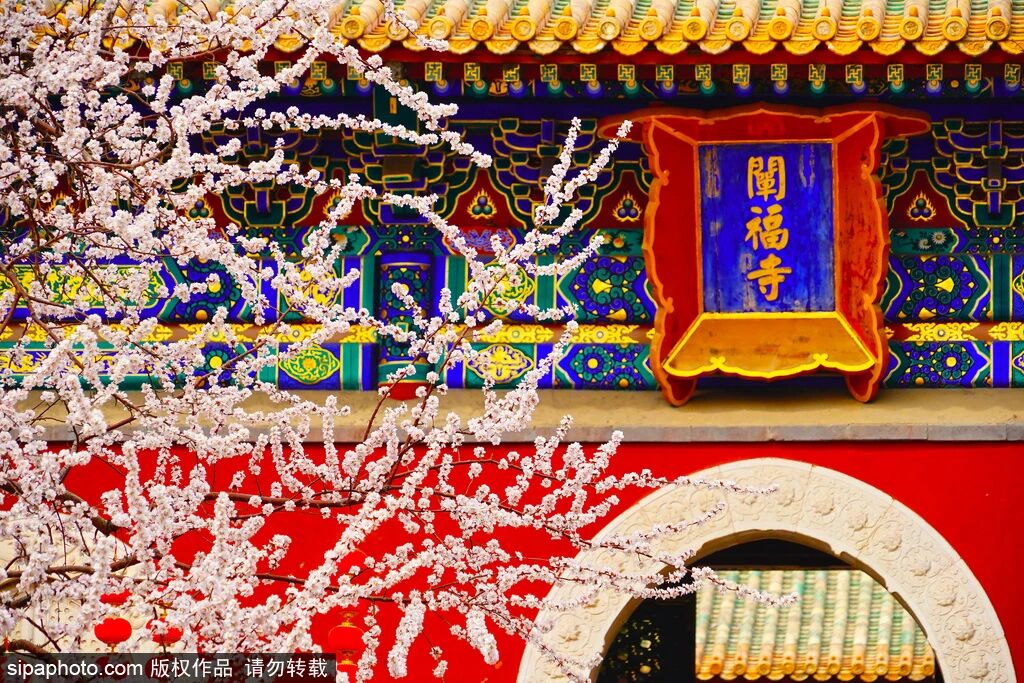
Lilac has long been a common motif in literary works, often symbolizing beauty, purity, and sorrow. People frequently use lilac flowers to represent young women, expressing deep emotions akin to those associated with lilac blossoms. In the words of Dai Wangshu, the girl who resembles a lilac flower seems to emerge from that rain-soaked alley, stepping into everyone's dreams.

The lilac plant is graceful, with a lush canopy, and its flowers come in shades of pale purple, white, and blue-purple. Elegant and noble, the flowers emit a rich fragrance. During their blooming season, they create a breathtaking view, with waves of purple stretching across the sky. Walking among lilacs, the refreshing scent envelops the senses.
Lilac has been cherished by the Chinese since ancient times, recognized as a traditional flower for admiring and enjoying its fragrance. Springtime lilac viewing is one of the most significant cultural events each year. Here are three recommended spots in Beijing to enjoy lilacs this spring: Fayuan Temple, Jietai Temple, and Temple of Heaven Park.
Recommended viewing period: April to May
Recommended locations: Fayuan Temple, Jietai Temple, Temple of Heaven Park
Fayuan Temple

Fayuan Temple was established in the 19th year of the Zhenguan era during the Tang Dynasty (645 AD) and is the oldest existing temple in Beijing. Originally named Minzhong Temple, it was renamed Fayuan Temple by the Qing Emperor Yongzheng, a name it has retained to this day. The temple is modest in size and is adorned with lilacs. In addition to purple and white lilacs, there are also lilacs from the Maluku Islands in Southeast Asia. Every April, the flowers bloom predictably, resembling clouds that envelop the red walls and blue tiles, creating a picturesque scene of "a fragrant sea of flowers in a beautiful place."
It is said that the lilacs at Fayuan Temple gained fame during the Ming and Qing Dynasties, being celebrated alongside the peonies of Chongyousi Temple and the crabapple blossoms at Prince Gong's Mansion as one of the three great floral events in the capital. Renowned figures such as Lin Zexu, Ji Xiaolan, and Gong Zizhen have left their footprints and poetry here. Even the Indian poet Tagore visited Fayuan Temple to admire the lilacs, accompanied by Xu Zhimo. April, often called the most beautiful month on earth, is also the most splendid season at Fayuan Temple.
Here's a little tip for finding lilacs at Fayuan Temple: the best area for viewing is between the Mahavira Hall and Minzhong Pavilion. Most of the purple lilacs are concentrated here, blooming the most vigorously and beautifully, with an especially strong fragrance. This spot is perfect for taking photos, especially with the plaque of Minzhong Pavilion and the incense burner in front, making for stunning pictures. It is said that five-petaled lilacs are quite rare; if you happen to find one, good luck is sure to follow—give it a try!
Besides enjoying the lilacs, Fayuan Temple is also a great place for cat lovers. There's a popular orange cat in the temple that is particularly adorable. Who knows, you might just have the chance to encounter it among the sea of lilacs!
Lilac Avenue in Temple of Heaven Park

On the west side of the Hall of Prayer for Good Harvests in Temple of Heaven Park, near the western cypress forest, lies the largest lilac grove in Beijing, covering an area of 6,300 square meters with 240 clusters of lilacs, many of which are nearly 50 years old—quite rare. In the bright spring light, the fragrant white and purple flowers release a captivating scent, making a stroll through this area feel like stepping into a fairy tale.
Though the lilac flowers are small, they bloom in dense clusters of white and purple. When they bloom, especially in the evenings, the rich fragrance wafts through the air, intoxicating those nearby. An evening visit to the Temple of Heaven, accompanied by the gentle scent of lilacs, is a wonderful choice!
Jietai Temple

Jietai Temple, located at the foot of Maanshan in the Mentougou District of Beijing, has a history of over 1,400 years and is one of the oldest royal temples still standing in the city. It is renowned for housing China's largest Jietai, which is used for conferring the highest Buddhist precepts, earning it the title "The First Altar Under Heaven." The temple is home to ancient pines and century-old flowers, offering significant cultural and natural value.
Jietai Temple boasts more than 1,000 lilac plants, including over 20 ancient lilacs that are more than 200 years old. These ancient lilacs were relocated from the Lilac embankment in Changchun Garden during the Qianlong era of the Qing Dynasty. The original lilac grove in Changchun Garden covered dozens of acres, creating a stunning sea of purple and white when in bloom. Unfortunately, the lilacs in Changchun Garden were destroyed by the Anglo-French Allied Forces in 1860, making the ancient lilacs at Jietai Temple a precious remnant.
Lilacs are the temple's preferred flowering plants due to their strong fragrance and heart-shaped leaves, symbolizing the belief that "sincere hearts yield spiritual results." The lilacs are distributed throughout the temple, with the oldest ones primarily found around the Zhongting Pavilion, Dicang Pavilion, Peony Pavilion, South Palace, and in front of the Mahavira Hall and Guanyin Hall.