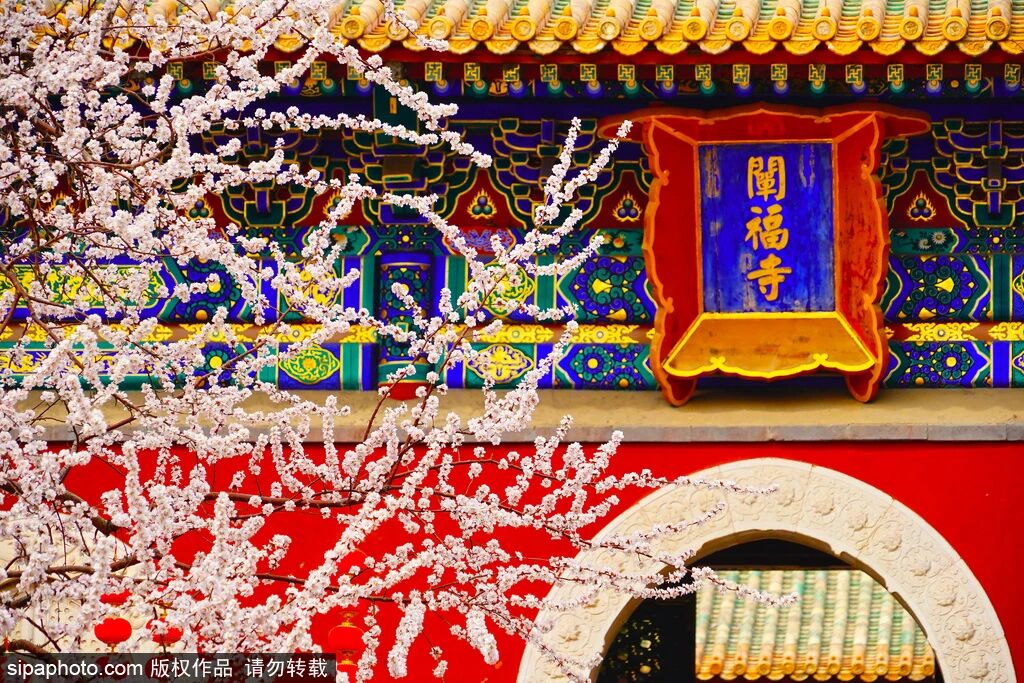
As the chill of early spring lingers and warmth begins to rise, magnolia flowers bloom, bringing a hint of fragrance to the brisk March air. With their round, full blooms and elegant stance, magnolias fill the trees with sweet scents as they unfurl their leaves gracefully. However, their flowering period is fleeting, embodying a bold, proud spirit. Notably, magnolias bloom before their leaves, which only deepens our admiration for them. In Beijing, prime spots for viewing magnolias include Dajue Temple, Tanzhe Temple, the Summer Palace, and Chang'anjie (Ave). Amid ancient architecture, beneath red walls, the elegant yet simple magnolias present a stunning sight.

Recommended viewing period: last week of March to mid-April
Recommended locations: Chang'anjie (Ave), Summer Palace, Tanzhe Temple, Dajue Temple
Chang'anjie (Ave)

In the heart of Beijing, the magnolias along Chang'anjie (Ave) serve as a herald of spring. Elder flower enthusiasts often say that the blooming of magnolias on this avenue signifies the true arrival of spring in the city.
The most beautiful magnolias are found on Xichang'anjie (Ave), where numerous trees face south, basking in sunlight and blooming as early as early March. The contrast of white flowers against red walls creates a majestic beauty, reflecting the artistic spirit of the ancient capital.
The northwest corner of the National Centre for the Performing Arts also features a patch of purple magnolias, creating an interesting interplay between the blossoms and modern architecture. At night, the various light shows at the theater enhance the magnolias' unique charm.
"Sea of Fragrant Snow" in the Summer Palace

The magnolias in the Summer Palace may be few in number, but they are renowned. Historical records show that the cultivation of magnolias there has a history of over 250 years. In front and behind the Hall of Joyful Longevity, magnolia trees were planted, remnants from the Qianlong era around 1750, when they formed a dense grove known as the "Sea of Fragrant Snow." However, during the occupation of Beijing by the Anglo-French Alliance in 1860, they were destroyed, leaving only two trees that have survived to this day, each over 200 years old, truly testaments to a rich and tumultuous history. When the magnolias bloom, entering the Hall of Joyful Longevity is greeted by a sea of fragrance, and the scent alone is enough to enchant anyone.
Admiring the magnolias in the Summer Palace, the harmony between the ancient architecture and the flowers is truly beautiful. The roof tiles and magnolias, the eaves and magnolias, the plaques and magnolias, the window frames and magnolias… The architecture is magnificent and orderly, while the magnolias are elegant and graceful. The two seem to converse like old friends.
In 2018, the Beijing Municipal Forestry and Parks Bureau and the Beijing Park Management Center organized an event across the city to find the "Top Ten Most Beautiful Trees in Beijing," and the ancient magnolia in the Summer Palace was recognized as one of them.
Tanzhe Temple

Tanzhe Temple is located at the foothills of Tanzhe Mountain in the southeastern part of Mentougou, western Beijing. In March, as spring brings warmth and flowers bloom, the magnolias in the city are already in full bloom, while the magnolias at Tanzhe Temple gradually reveal their graceful forms. Inside the temple, white, yellow, purple, and "Erqiao" magnolias bloom in competition.
On the east side of the Pilu Pavilion within the temple, there are two "Erqiao" magnolias, each over 10 meters tall and providing shade over 20 square meters. They typically enter their flowering period around late March to early April. The name "Erqiao" is a title given by people; the original name was "Zhushayulan".
What does "Erqiao" mean? It refers to the two beautiful daughters of the famous figure Qiao Gu in the Eastern Wu state during the Three Kingdoms period, namely Daqiao and Xiaoqiao.
The flowers of the "Zhushayulan" have two colors: purple on the bottom and white on the top, resembling two ladies of different styles, hence the name "Erqiao" magnolia.
Today, most newly cultivated varieties of "Erqiao" magnolias around the world have been developed through grafting techniques by the French, with a history of just over 100 years. In contrast, the two "Erqiao" magnolias in Tanzhe Temple were planted in the mid-Ming Dynasty and are now over 400 years old, demonstrating that the flower cultivation techniques in China at that time were already quite advanced and refined.
Dajue Temple

Dajue Temple is praised for its "Eight Wonders": the fragrance of ancient orchids, a thousand-year-old ginkgo tree, old vines entwined with cypress, buckthorns growing on cypress, a spiritual spring, ancient stele from the Liao Dynasty, pines and cypress embracing the pagoda, and the clear pond, with "ancient orchid fragrance" taking the lead. When appreciating magnolias at Dajue Temple, one must not miss the 300-year-old ancient magnolia in front of the Siyi Hall, which is said to have been personally transplanted from Sichuan by Master Jialing during the Yongzheng period. Standing over 10 meters tall, it has a large crown and fist-sized white double petals that emit a delightful fragrance.
People admire magnolias for their purity, and their beauty lies not only in the flowers but also in their curved branches, which resemble traditional Chinese paintings, beautifully complementing the ancient, solemn temple architecture. Gazing up at the plaque inscribed by Emperor Qianlong, reading "No Coming or Going," one can truly sense the Zen and mystery in the air. If, while enjoying the magnolias, one were to sip on a pot of pre-Qingming Longjing green tea at Huiming Teahouse, savoring the tea and the flowers while letting thoughts drift in the gentle spring breeze, it would be a remarkable sense of relaxation and leisure.
The magnolias at Dajue Temple have attracted countless poets and writers, including Nalan Xingde from the Qing Dynasty, and modern figures like Zhu Ziqing, Hu Shi, Pu Xinshe, Zhang Boju, Yu Pingbo, and Bingxin, all of whom have left behind beautiful writings.
Magnolias in mountain temples like Tanzhe Temple and Dajue Temple bloom later, as if the flowers slow down time, providing busy people with a chance to enjoy the spring. The delayed arrival of spring seems to preserve precious moments of this season for all of us.
Beijing International Sculpture Park

Where can you see the most magnolias in Beijing? The answer is the Beijing International Sculpture Park.
Known for its sculptures, the park features over 180 outstanding pieces from more than 40 countries and regions. However, it has even more magnolias. Currently, the park boasts over 5,000 magnolia trees, including varieties such as white, purple, red, flying yellow, multi-petal, danxin, Erqiao, and clumping magnolias. The "Magnolia Garden", covering an area of 5 hectares, has become one of the largest specialized magnolia viewing gardens in Beijing today.