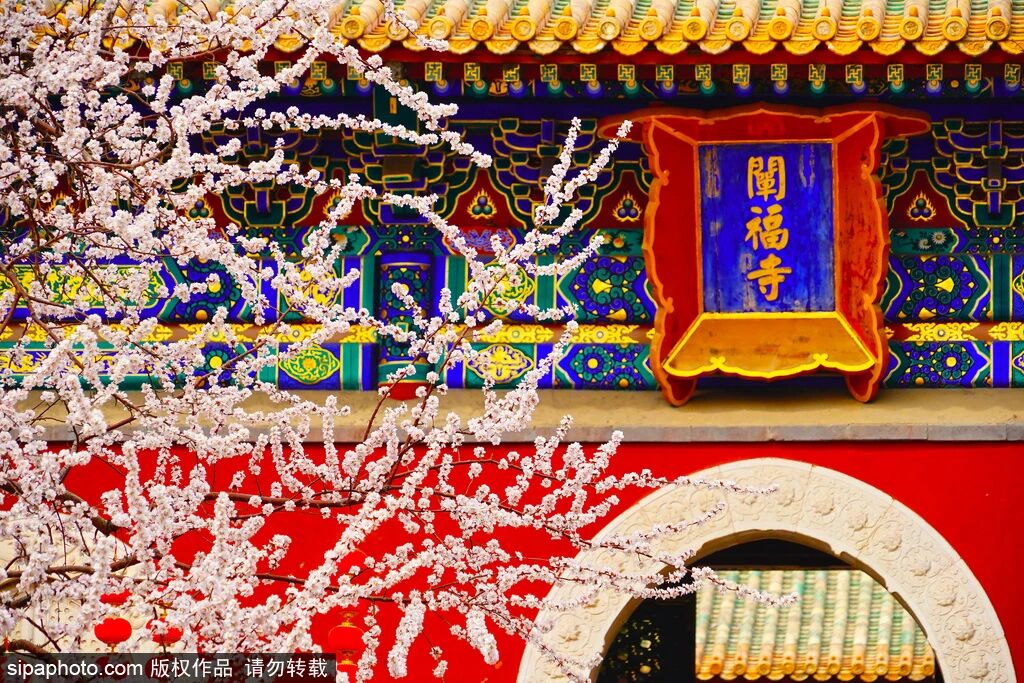
The total route is 3.9 kilometers long and includes four boutique streets: Hongfeng Lu (Rd), Jiewangfu Lu (Rd), Maimai Jie (St), and Meichang Jie (St). Along the way, visitors pass by the Xiangshan Museum of Founding of New China, Tong Lingge Memorial Hall, Xiangshan Park (Fragrant Hills Park), and Biyun Temple, all popular tourist spots. Surrounded by the Three Hills and Five Gardens, with ancient red walls, green pines, and historic buildings, every snapshot captures a beautiful scene.
Xiangshan Park (Fragrant Hills Park)

Xiangshan Park (Fragrant Hills Park) is located in the western suburbs of Beijing. With rugged terrain and lush, continuous greenery, it covers an area of 188 hectares and is a royal garden with distinctive mountain and forest characteristics. The main peak in the park, Xianglu Feng (Incense Burner Peak), is commonly known as "Guijianchou (Ghosts' Dread)" and has an elevation of 575 meters.

Xiangshan Park (Fragrant Hills Park) was originally built in the 26th year of the Jin Dynasty's Dading era, nearly 900 years ago. As early as the Yuan, Ming, and Qing dynasties, the royal family constructed palaces and villas in Xiangshan, where emperors would come to hunt and relax during the summer and autumn. Xiangshan Temple was once the most prominent temple in the western suburbs of Beijing. In the 10th year of Emperor Qianlong's reign (1745), extensive construction was undertaken to create the renowned "Twenty-Eight Scenic Spots", and Emperor Qianlong named the area Jingyi Yuan (Jingyi Garden). Xiangshan Park constitutes one of the "Three Hills and Five Gardens" in the western suburbs, being both one hill (Xiangshan) and one garden (Jingyi Yuan). The park was twice burned down by foreign forces, first by the Anglo-French Alliance in 1860 and then by the Eight-Nation Alliance in 1900. In 1956, it was opened to the public as a People's Park.

Xiangshan Park is home to numerous cultural relics and historical sites, with pavilions, terraces, and towers scattered like stars amidst the mountains and forests. Among them is "Xi Shan Qing Xue", one of the Eight Great Views of Beijing; Biyun Temple, which combines architectural styles from both the Ming and Qing dynasties; the only remaining wooden gilded "Wubai Luohan (Five Hundred Arhats)" in China; Zongjing Dazhao Temple the palace that hosted the 6th Panchen Lama; and Jianxin Zhai, an elegant courtyard with the distinct charm of southern China.

Biyun Temple was originally built in the 2nd year of the Zhishun era of the Yuan Dynasty (1331) and was initially named Biyun An. It was renovated and expanded during the Zhengde and Tianqi eras of the Ming Dynasty (1271-1368) and the Qianlong era of the Qing Dynasty (1736-1795), achieving its current scale. The entire temple covers about 40,000 square meters, with its main structures arranged along an east-west axis and divided into six courtyards. Each group of halls rises with the mountain's natural slope, creating a grand and magnificent sight. Biyun Temple was listed by the Beijing Municipal Government as one of the first key cultural relics protection sites in 1957 and was designated a historical and cultural site protected at the national level in 2001.
Shuangqing Villa was named by Emperor Zhangzong of the Jin Dynasty as "Menggan Spring" due to the two clear and cool springs that flow from the rocks. In the 10th year of Emperor Qianlong's reign (1745), it was rebuilt and named "Songwu Yunzhuang (Pine Lodge Cloud Villa)". Emperor Qianlong, finding the spring water refreshing and sweet, renamed it "Shuangqing (Double Clarity)". In 1917, during a flood in Zhili, Xiong Xiling founded the "Xiangshan Kindergarten" and turned this place into his private villa, naming it "Shuangqing Villa". Shuangqing Villa later became the residence and workplace of the great leader Mao Zedong.
On March 25, 1949, when the Central Committee of the Communist Party of China moved to Xiangshan, Chairman Mao directed the Yangtze River Crossing Campaign and laid the foundation for the new China from Shuangqing Villa, composing the famous poem The People's Liberation Army Captures Nanjing, opening a new chapter in China's history.

In 2019, under the care of the central and municipal governments, the old revolutionary sites at Xiangshan, including Shuangqing Villa, were restored and opened to the public on September 13. These historical sites are concentrated in the southern foothill area, comprising eight locations: Shuangqing Villa— Mao Zedong's office and residence, Laiqing Xuan— Office and residence of Zhu De, Liu Shaoqi, Zhou Enlai, and Ren Bishi, Bungalows east of Shuangqing Villa — Central Security Office, Siqin She (House of Remembrance) —Publicity Department of the Chinese Communist Party, Duoyun Ting (Pavilion of Many Clouds) —Publicity Department of the Chinese Communist Party, Xiaobai Lou (Little White Building) — Library of the Central Committee of the Chinese Communist Party, Lizhu Building — Xiangshan special telephone bureau of the Central Committee of the Communist Party of China, Zhenfang Lou (Zhenfang Building) and Zhennan Fang (Zhennan House) — Confidential Office of the General Office of the Central Committee of the Chinese Communist Party.
Xiangshan Park is home to an abundance of trees, with a forest coverage rate of up to 96%. It boasts more than 5,800 ancient and famous trees, accounting for one-quarter of all such trees in the Beijing urban area, making it one of the regions with the highest concentration of negative oxygen ions in Beijing. The park's rich natural and cultural features, including "mountains, famous springs, ancient trees, and red leaves", create a unique garden environment. It is a popular summer resort and a natural oxygen bar.
The red leaves of Xiangshan are famous both in China and abroad. In 1986, they were recognized as one of the "New Sixteen Sights of Beijing", becoming the most vivid symbol of autumn in the capital. The red leaves in Xiangshan come from 14 tree species across 8 botanical families, with a total of 140,000 trees planted over an area of approximately 1,400 mu (about 93 hectares), creating a spectacular view. The park has more than 100,000 Huanglu (Chinese smoketrees), covering 1,200 mu (about 80 hectares), making them the dominant species contributing to the red foliage in Xiangshan. The leaves of the red-leaf species contain a large amount of chlorophyll, xanthophyll, carotenoids, carotene, and anthocyanins. During spring and summer, chlorophyll conducts photosynthesis, turning the leaves green. In the frosty autumn, as the weather cools and the temperature difference between day and night increases, chlorophyll production is hindered and gradually breaks down. Meanwhile, carotenoids, carotene, and anthocyanins increase, causing the leaves to display beautiful red, yellow, and orange hues.
Xiangshan Park has been recognized as a Capital Civilized Unit since 1993. In 2001, it was rated as a AAAA Scenic Spot by the China National Tourism Administration. In 2002, it was named one of the first boutique parks in Beijing. In 2004, the park obtained certifications for the ISO9001 International Quality Management System and the ISO14001 International Environmental Management System. In 2020, it was awarded the title of National Civilized Unit.