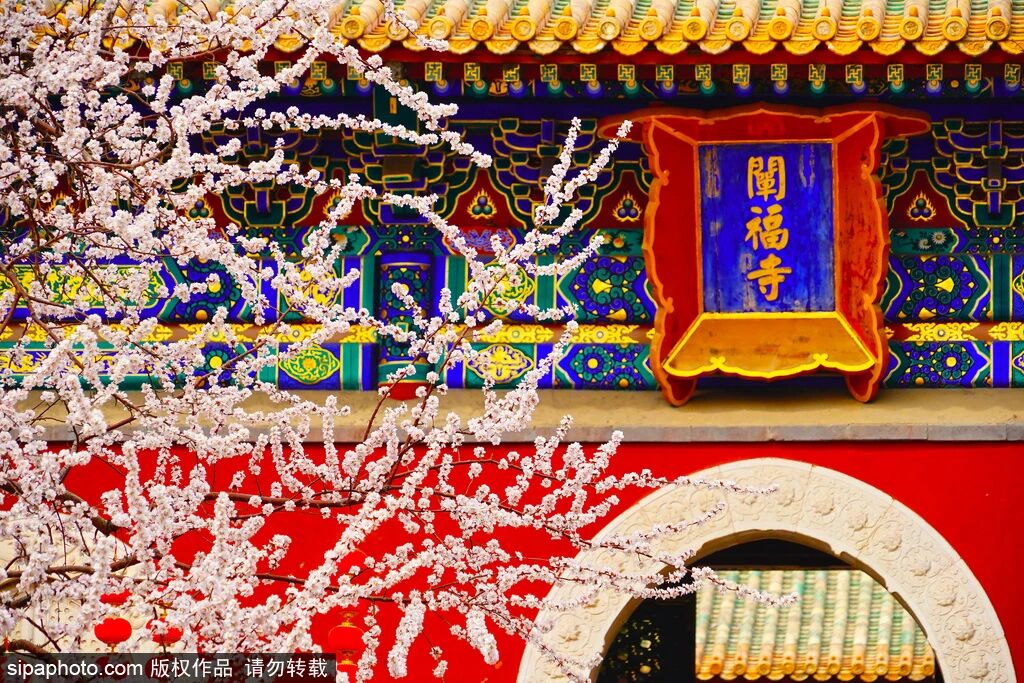
Amidst the city's hustle and bustle, the Hutong residences are like a tranquil harbor, bearing the memories of history and the warmth of human culture. As I gently step into the winding and secluded Hutongs, a unique sense of tranquility and peace envelops me. The cobblestone paths beneath my feet seem to narrate the prosperity of the past, and behind each tightly closed door lies countless touching stories and the vicissitudes of time. Let us venture into the Hutongs to explore the people and events within these former residences.
Former residence of Lao She
The former residence of Lao She is located at No. 19 Fengfu Hutong, off Dengshikou West Street, Dongcheng District, Beijing. Lao She lived in a total of ten residences in Beijing before and after the liberation, with nine before and one after. The residence at No. 10 Naizhi Mansion, Fengfu Hutong (now renumbered to No. 19), was his home following the liberation until his passing. He lived here for 16 years, a period in which he achieved his life's most brilliant literary accomplishments.

Upon entering through the main gate, one is greeted by a brick screen wall and two small southern rooms, which served as the living quarters for the gatekeeper. After moving in, Mr. Lao She planted a jujube tree next to the main gate by the street wall. Behind the screen wall, he had a Taiping flower transplanted, a renowned variety unique to the Imperial Garden of the Forbidden City. It flourished into a large cluster, over one person's height, with a two-meter diameter, covered in pure white blossoms and emitting a rich, pervasive fragrance.

Behind the screen wall lies a small outer courtyard that forms its own system, with three gray-roofed rooms. This courtyard has a street gate leading to Naizhi Mansion Street, which has never been used. The open space of the outer courtyard became Mr. Lao She's flower bed, where he once planted chrysanthemums and dahlias, with over a hundred pots.
The inner courtyard features five north-facing rooms, and three each to the east and west, all with gabled tile roofs, surrounding a small, square courtyard. After passing through the main gate and the Taiping flower, there is a second gate that leads to the inner courtyard. Beyond this gate, a green-painted wooden screen wall stands. There are cross corridors leading to the east, north, and west rooms, with the ground outside the corridors covered in soil. A lifelong lover of flowers and plants, Mr. Lao She had two persimmon trees transplanted from the Western Hills, one on each side of the corridor. Because of these trees, his wife, Hu Jieqing, later named the small courtyard "Dan Shi Xiao Yuan" (Persimmon Courtyard) and her own painting studio "Shuang Shi Zhai" (Double Persimmon Studio). After Mr. Lao She's death, the Japanese writer Min Ono wrote three memorial articles, all titled with references to these persimmon trees, namely Crickets, Gourds, and Persimmons, Persimmons in Beijing, and The Words of Persimmons. The persimmon tree has thus become a symbol of this courtyard.

In the three main north-facing rooms, two serve as a living room, and the one at the east end is the wife's painting studio and bedroom. The east ear room is the bathroom, equipped with a flush toilet and bathtub. The west ear room is Mr. Lao She's study and bedroom, where he spent his later years for 16 years. During this time, he created 24 dramatic scripts and two novels, including the acclaimed works Longxugou (Dragon Beard Ditch), Willow Tree Well, Looking West to Chang'an, Teahouse, Female Sales Clerk, Family Happiness, and Under the Red Flag. The play Dragon Beard Ditch earned him the honorable title of "People's Artist." The play "Teahouse" has become a repertoire of the Beijing People's Art Theatre and represented Chinese drama abroad for the first time, enjoying a high reputation in Europe, America, and Asia.


The furnishings in the living room are arranged strictly according to Mr. Lao She's wishes, reflecting his taste, hobbies, and character. The living room features an array of flowers and numerous paintings, with about 10 Chinese paintings hung on the walls, mainly works by Qi Baishi, Fu Baoshi, Huang Binhong, Lin Fengmian, and others, making it akin to a small art gallery.


When an elderly man, brimming with the taste and passion of life, creates a home he has longed for, that home is destined to be extraordinary. Mr. Lao She's home is distinguished by its rich Oriental cultural hues. It is indeed charming, a home filled with enchantment.

Address: No. 19 Fengfu Hutong, Dengshikou Xijie(St), Dongcheng District, Beijing
Former residence of Ji Xiaolan
The Former Residence of Ji Xiaolan, also known as Yuewei Caotang, is located at No. 241 Zhushikou Xidajie(St), Xicheng District, Beijing, recognized as a municipal-level protected cultural heritage site in the city.


The existing structure of Ji Xiaolan's Former Residence reflects traditional Qing Dynasty architecture, characterized by brick and wood, with a layout oriented from north to south, approximating a two-entry courtyard house, or siheyuan, covering an area of 1,570 square meters. The main entrance, embellished with auspicious designs and topped with a hard mountain gate tower, is positioned at the southeast corner of the property. Adjacent to the south wing and to the west of the gate, lie four "inverted seat" rooms that open to the exterior. A wisteria vine stands in the front courtyard, believed to have been planted by Ji Xiaolan himself, which still flourishes, offering a dense shade. The primary building in the rear courtyard, "Yuewei Caotang," contains a screen in the middle of the northern hall side, with a horizontal plaque inscribed with "The Former Site of Yuewei Caotang," personally signed by Mr. Qi Gong.


This residence has endured for over two centuries, bearing numerous historical traces and a rich cultural heritage. Following Ji Xiaolan's passing, the property was sold by his descendants. In the 1920s, it was the residence of Liu Shaobai, a member of the Beiyang Government, and was known as "Liu Mansion." In 1930, it served as a secret meeting point between the Central Committee of the Communist Party of China, based in Shanghai, and the Hebei Provincial Committee. In 1931, the Beijing National Drama Society was established here by Mei Lanfang, Yu Shuyuan, Li Shizeng, Zhang Boju, and others, which later became the base for the "Fuliancheng" Peking Opera troupe. After 1949, it functioned as the venue for the China Democratic League and the Xuanwu Party School.


In 2003, the Former Residence was renovated and made accessible to the public. The museum now displays the Jingcheng Ji Clan Genealogy,Critique of the Carving of the Dragon, Transcendental Collection of Works, Notes from Yuewei Caotang, as well as Ming and Qing dynasty porcelain donated by Ji Xiaolan's sixth-generation granddaughter, Ji Qingyi.
Address: No. 241 Zhushikou Xidajie(St), Xicheng District, Beijing
Former residence of Mao Dun


Secluded in Houyuan Nisi Hutong, within the Nanluoguxiang neighborhood in Beijing's Dongcheng District, lies a quaint courtyard that once served as the home of Mao Dun, a luminary of modern Chinese literature. Mr. Mao Dun took up residence here at the end of 1974 and continued to live in this peaceful enclave until his demise in March 1981, marking the final seven years of his illustrious life.


Throughout his life, Mao Dun primarily resided in his hometown of Wuzhen, Shanghai, and Beijing. Today, the locations where he lived and worked in these cities have been meticulously preserved. In 1984, three years after his passing, his Beijing residence was designated as a protected cultural heritage site and was inaugurated as a literary exhibition hall. The exhibition hall pays homage to Mao Dun as an esteemed revolutionary writer, cultural figure, and social activist, and recognizes his pioneering role in the annals of modern and contemporary Chinese literature. Along with Lu Xun and Guo Moruo, he was instrumental in establishing the foundation of China's revolutionary literature and cultural movement—a succinct encapsulation of his lifelong dedication to the cause of literature and revolution.


Upon entering the courtyard from Houyuan Nisi Hutong, visitors are greeted by a partition wall that displays a black marble plaque inscribed with "Former Residence of Mao Dun," graced with gold calligraphy by Comrade Deng Yingchao. The courtyard is a classic two-entry siheyuan, or courtyard house, linked by a narrow passage from the front to the back yard.
The front yard is composed of the main chamber, east and west wing rooms, and a reverse seat room, which enclose a central courtyard and form a quintessential siheyuan. The west wing room initially functioned as Mao Dun's reception and study area. The east wing room acted as the dining room, while the remaining spaces were allocated for the living quarters of family members and staff. In the southern part of the front yard stands a square grape trellis, rumored to have been the site of a swing installed by Mr. Mao for playtime with his granddaughter. To the north, a white marble bust of Mr. Mao is mounted on a bluestone pedestal. After Mao Dun's death, relevant departments established the first and second exhibition rooms in the front yard, showcasing numerous photographs and personal items of Mr. Mao, including manuscripts, publications, correspondence, literary journals he edited, and everyday items such as inkwells and teacups.


The back yard features six rooms to the north and two to the west. The northern rooms were originally Mr. Mao's living room and bedroom, arranged as they were during his lifetime with all the furnishings being his personal belongings. The room at the main entrance was Mr. Mao's living room, lined with bookshelves as they were during his life. A writing desk is positioned by the east window, and an eastern door leads to the bedroom. In his later years, due to mobility issues with his legs, Mr. Mao primarily resided in the back yard rooms.

Beneath the eaves of the north room in the back yard, an old "GE" brand refrigerator is still preserved. It was purchased by Mr. Mao's wife, Kong De'an, from a second-hand market after they settled in Beijing in 1949 and was in use for two to three decades.


This year, as we commemorate the 43rd anniversary of Mao Dun's passing, his former residence stands as a silent witness, connecting Mao Dun's life with his era, inviting visitors to pay tribute to the legendary life of this literary revolutionary and to immerse themselves in his literary domain.
Address: No. 13 Houyuan Nisi Hutong, Dongcheng District, Beijing
Former residence of Qi Baishi

The former residence of Qi Baishi is a quintessential Beijing siheyuan, a courtyard house that faces south and is nestled in the heart of the city. During the midsummer season, the verdant trees and their rustling branches create a tranquil environment. Within the serene courtyard, one can observe a crabapple tree, a pomegranate tree, two magnolias, and two rose bushes, casting a mottled shade on the ground. In the courtyard's center stands a life-sized statue of Mr. Qi Baishi, leaning on his cane amidst the lush magnolias, gazing intently into the distance.


It is believed that this freestanding siheyuan was built during the mid-to-late Qing Dynasty for a high-ranking official of the Imperial Household Department. The original complex was grand, and the current residence at No. 13 is just a segment of it. The official was accused by his peers for misusing construction materials from the imperial palace and for exceeding building standards. As a result, the property had to be divided and sold off, leading to the formation of this independent courtyard house. After the establishment of the People's Republic of China, the Ministry of Culture acquired this courtyard to be the residence for Mr. Qi Baishi. However, Qi Baishi, who had a strong attachment to his old residence at No. 13 Kuai Che Hutong, Beicai Hutong, Xicheng District, only briefly lived here before returning to Xicheng. Following Qi Baishi's departure, this place was converted into the Qi Baishi Memorial Hall.

The courtyard is composed of three rooms on each of the south, north, east, and west sides, linked by corner corridors. At the junction of the porch and the courtyard, a stone landscape, two green lotus plants, adjacent bamboo, and the gray walls together craft an artistic space that is minimalist yet well-organized, ideally complementing Mr. Qi Baishi's simple and spirited artistic style. Qi Baishi painted scenes of shrimp, radishes and cabbages, and chicks foraging for food— all ordinary life scenes. His pure and succinct ink language reflects both the warmth of human life and the profound realm of literati painting. The worth of a painting is not contingent upon the subject but upon the artist's cultivation. Qi Baishi once visited the Yangtze River to sketch but was so captivated by the scenery that he spent the entire day without making a single stroke. A decade later, when he painted, the canvas included only one stone and one bird, with the rest left blank. The use of negative space is a sophisticated artistic technique in Chinese painting, generating boundless atmospheres without the need for ink. Simplicity to the extreme is also beauty to the extreme. It is evident that the creation of this small corner scene is truly ingenious.


In the spacious courtyard, several square tables and brown rattan chairs are scattered around. Perhaps in the midsummer of those bygone years, this is where Mr. Qi Baishi would entertain his guests. With great scholars in deep conversation, a pot of green tea, and a gentle breeze, they would discuss the world's vicissitudes.

Address: Courtyard No. 13, Yu'er Hutong, Dongcheng District, Beijing