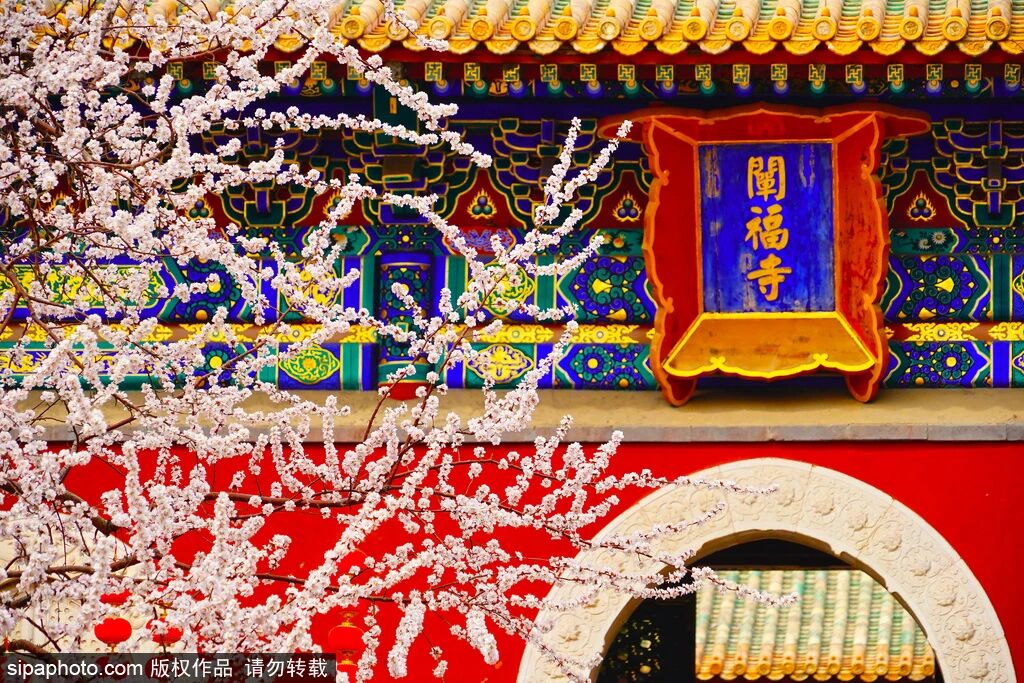
Beijing's history and stunning landscapes intertwine, with imperial gardens rich in cultural heritage. Recently, several ancient courtyards have been restored and reopened to the public, breathing new life into these historic parks.
Xiangshan Park·Biyun Temple

Biyun Temple at Xiangshan Park has recently completed its restoration and reopened to the public on September 26. Established in the second year of the Yuan dynasty's Zhishun era (1331), the temple underwent expansions during the Ming and Qing dynasties. Notably, it served as a royal temple and palace during the Qing dynasty, shaping its current layout and scale.

The entire temple is built in accordance with the mountain's terrain, rising in tiers.


Within the temple, ancient trees soar, and springs surround the area. With distinct seasons and stunning scenery, the site preserves architectural elements from the Ming and Qing dynasties, along with many exquisite stone carvings and sculptures.


The Vajrasana Pagoda is located at the deepest part of the pagoda courtyard, facing east from the west. It is the tallest Vajrasana Pagoda in the country, entirely constructed from white Han marble. This pagoda represents the pinnacle of stone carving art during the prosperous period of the Qing dynasty and appears exceptionally majestic from a distance.


The Arhat Hall was built in the 13th year of the Qianlong reign and covers an area of over 1,100 square meters, featuring a distinctive architectural style. Inside, there are 508 wooden.


In late autumn, visiting Biyun Temple offers the chance to admire the ancient temple's red walls alongside the golden ginkgo trees.


The unique double gates of Biyun Temple harmonize beautifully with the surrounding trees, making it an excellent spot for photography.


Opening Hours: Closed on Mondays, except for public holidays. From April 1 to November 15, the temple opens at 8:00 AM, with last entry at 5:00 PM and closing at 5:30 PM. From November 16 to March 31 of the following year, it opens at 8:30 AM, with last entry at 4:30 PM and closing at 5:00 PM.
Ticket Price: Tickets must be purchased separately. 10 yuan per person (no reservation needed; tickets can be bought on-site).
Address: No. 40, Maimai Dajie (St), Haidian, Beijing, approximately a 500-meter walk towards the north gate of Xiangshan Park.
Mei LanFang Memorial Museum
Starting from September 20 this year, the Mei Lanfang Memorial Museum has reopened with new spaces, including digital interactive areas and an audio-visual room. For the first time, the museum showcases Mei Lanfang's personally arranged daily schedule, a catalog of his collection of domestic and international records, and the performance programs of the four great Dan actors appearing on stage together.

The permanent exhibition features nearly 200 photographs and 85 items (or sets) of artifacts. In the special exhibition, 34 items (or sets) showcase Mei Lanfang's journey in collecting and creating paintings, highlighting his innovative spirit of integrating opera and painting.

Address: No. 9, Huguosi Dajie (St), Xicheng, Beijing.
Summer Palace · Yangyun Pavilion
The main building and courtyard system of Yangyun Pavilion at the Summer Palace have been restored and will open in mid-October. Yangyun Pavilion is a group of four traditional courtyards located north of the Long Corridor and west of the Yangerfeng Garden at Hall of Happiness in Longevity (Leshou Tang). The south entrance features a stone bridge connecting to the Long Corridor, with a gourd-shaped pond situated beneath the bridge.


Address: No. 19, Xinjian Palace Gate Road, Summer Palace, Haidian, Beijing.
Zizhuyuan Park · Palace of the Emperor's Retreat
Located in the southern part of Haidian, Zizhuyuan Park is a natural landscape garden characterized by its lush bamboo scenery, featuring countless bamboo stalks. The Palace of the Emperor's Retreat is situated in the northwest of Zizhuyuan Park and served as a resting place for emperors and empresses during visits to the Wanshou Temple and Suzhou Street. The restoration work on the palace is nearly complete, and it is expected to be unveiled in its new form by the end of the year, showcasing the rich history of this "Qing Dynasty Palace."


Within the palace, two ancient ginkgo trees were planted during the Ming Dynasty's Wanli period. In the golden autumn, the radiant ginkgo trees create a spectacular scene, standing out prominently amid the surrounding ancient architectural complex.

Address: No. 35, Zhongguancun Nandajie (S, St), Zizhuyuan Park, Haidian, Beijing.
Jinzhongdu Park
The park is located on the cultural belt of the Ruins of the Central Capital of the Jin Dynasty, extending in an "L" shape through the core area of the financial and business district. Following the principle of "matured sections opened up as they are implemented," the park has opened 7 sections covering a total area of 113 acres.

The Ruins of the Central Capital of the Jin Dynasty, located in Fengtai District, mark the starting point of Beijing's status as a capital and serve as tangible evidence of nearly 870 years of the city's history as a capital. In the future, the Jinzhongdu Park will be developed into an immersive archaeological landscape, an engaging new urban landmark, and an open city museum.


The park incorporates cultural elements, such as traditional opera and literary craftsmanship, to recreate and interpret the history and culture of the Jin Dynasty.


Address: Southwest of the National Academy of Chinese Theatre Arts, Dongguantou Dajie (St), Fengtai, Beijing.
Archaeological Site of Wenyuan Pavilion in Yuanmingyuan
The Wenyuan Pavilion are located in the northwest part of the Yuanmingyuan and serve as a garden landscape centered around a royal library. It is one of the seven major pavilions housing the complete collection of the "Four Categories" from the Qing Dynasty.

Starting from August 26, 2024, the Beijing Archaeology Institute, in collaboration with the management office of the Yuanmingyuan in Haidian District, will begin partial archaeological excavations of the Wenyuan Pavilion ruins, with an intended excavation area of 1,000 square meters.


This year's archaeological excavation site at the Wenyuan Pavilion will be open to the public throughout the entire process. Citizens and visitors can observe the archaeological work during the excavation, which is expected to continue until the end of October.
Address: Northwest Scenic Area of the Yuanmingyuan, No. 28, Tsinghua Xilu (W, Rd), Haidian, Beijing.
Beijing Huatian Art Museum

On September 20, the Beijing Huatian Art Museum officially opened its doors. This exhibition will run until October 20, featuring special guided tours. Citizens and visitors can make reservations to explore the museum and experience the "movable type printing" process by creating stamped postcards, as well as interact with AI digital beings.

As the first art museum dedicated to a time-honored restaurant brand in the capital, this exhibition features nearly 50 selected artistic treasures.


Address: 4th Floor, October Building, No. 14A, Xinjiekou Waidajie (St), Xicheng, Beijing.
Translator: BAI Jing
Reviewer: NIU Lihua