
In the ancient yet modern city of Beijing, there is a central axis running from north to south. In July this year, the "Beijing Central Axis—A Masterpiece of Urban Planning in China's Ideal Capital" was officially inscribed on the World Heritage List. Developed over more than seven centuries, the Beijing Central Axis is not only a geographical coordinate but also a profound accumulation of Chinese culture and wisdom. Today, "China's New Landmarks" takes us along with reporters to appreciate the unique charm and enduring vitality of the Beijing Central Axis.
On July 27, local time, at the 46th session of the UNESCO World Heritage Committee held in New Delhi, India, the "Beijing Central Axis—A Masterpiece of Urban Planning in China's Ideal Capital" was officially inscribed on the World Heritage List. This is the world's best-preserved urban axis, starting from the Drum and Bell Towers in the north, passing through Wanning Bridge, Jingshan, the Forbidden City, Duanmen, Tiananmen, Zhengyangmen, and extending to Yongdingmen in the south. The Temple of Heaven and the Altar of Agriculture, along with the Imperial Ancestral Temple and the Altar of Land and Grain, are located on the east and west sides of the central axis, forming the world's longest urban axis at 7.8 kilometers. The Beijing Central Axis was initially built in the 13th century and took shape in the 16th century, undergoing continuous improvement over more than seven centuries to become the grand, orderly, and balanced urban axis it is today. It stands as an outstanding example of the mature stage of the central axis development in traditional Chinese capitals. What unique value does the Beijing Central Axis possess to become a World Heritage site? We follow Lü Zhou, the head of the Beijing Central Axis World Heritage application text compilation team, to the highest point of the central axis—Wanchun Pavilion in Jingshan Park.
The series of ancient buildings on the Beijing Central Axis are well-known, but what value does the whole they form possess? Let's first fly over this urban axis together. You will see ancient royal palace buildings and sacrificial buildings with the most traditional Chinese features, as well as modern art buildings led by Western architects, all converging here. The collision of history and modernity has created today's Beijing Central Axis.
The initial design of the Beijing Central Axis was based on the traditional Chinese concept of "choosing the center." Over the following seven centuries, this paradigm has consistently guided Beijing's urban development.
Today, the Beijing Central Axis has created a cityscape that cleverly integrates modern urban and historical spaces. The Wupailou at Qianmen on the Beijing Central Axis had its paint layer cracked and lost its luster due to years of exposure to wind and sun. In 2022, experts in ancient building painting and decoration adhered to traditional painting methods to refurbish the Wupailou, presenting a grand and magnificent visual effect. As a World Heritage site, the Beijing Central Axis is also a scene of daily work and life for the people, making it a "living heritage." At the southern end of the Beijing Central Axis, the reconstructed Yongdingmen has now become a popular spot for leisure and tourists.
Tang Huade, 78, has lived in Zhonggu Hutong on the Beijing Central Axis for 20 years and has witnessed the changes in people's lives along the central axis.
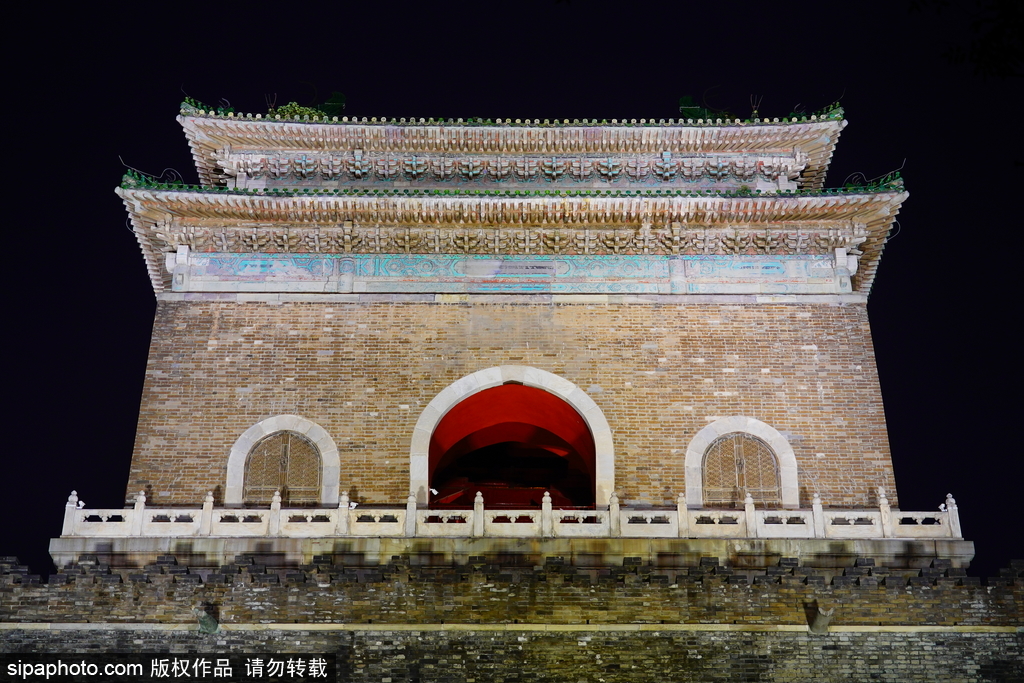
At the northern end of the Beijing Central Axis, the Drum and Bell Towers have become a new popular check-in spot. In recent years, digital interactive exhibitions and immersive exhibition halls in the central arch have been added, allowing visitors to understand the history of the Drum and Bell Towers and the "story of time" in China from multiple perspectives, including images, sounds, and texts. This summer, the "I Am at the Drum Tower" life festival was held here. Wearing AR glasses, visitors could experience a guided tour that made them feel like they were exploring the wonders of the Drum Tower; with VR headsets, they could embark on a time-space journey of the Beijing Central Axis. The real-life artifact-based storyline study further helped children establish the concept of time that Chinese people have respected and adhered to throughout history. Using AR to awaken the memory of cultural relics, what historical changes will they reveal about the Drum and Bell Towers? What stories of the planners of the Beijing Central Axis are hidden behind the map? Here, children happily transform into the "guardians of time" of the new era.
Such chimes once set the "standard time" for the capitals of the Yuan, Ming, and Qing dynasties, guiding the city's residents to work at sunrise and rest at sunset with the "morning bell and evening drum." As time progresses, the Beijing Central Axis is now bursting with new vitality. To the south of Yongdingmen, the world's largest single airport terminal—Beijing Daxing International Airport—connects the world with an open posture. To the north of the Drum and Bell Towers, the axis runs through the Bird's Nest, Water Cube, and Olympic Forest Park, showcasing China's new concepts of "green, technology, and humanity." The capital of a great nation is endowed with the significance of integrating ancient and modern on the traditional central axis. As a new member of the "China team" of World Heritage sites, the Beijing Central Axis tells the world the story of the development of Chinese civilization and its contribution to human civilization, revitalizing unique World Heritage through inheritance, protection, and promotion.


