
As the core symbol of Beijing, the capital of China, Beijing Central Axis carries rich historical and cultural heritage and urban development footprint. On July 27, 2024, Beijing Central Axis was successfully inscribed on the World Heritage List at the 46th session of the World Heritage Committee, which is not only an affirmation of Beijing's and even China's traditional culture, but also shows the world China's profound cultural heritage and unique urban planning wisdom.
Sitting at the northern and southern ends of the Beijing Central Axis are the Bell and Drum Towers and the Yongding Gate respectively. Lying between the two ends are Jingshan Hill, the Forbidden City, the Upright Gate, the Tiananmen Gate, the Outer Jinshui Bridges, the Tian'anmen Square Complex, the Zhengyangmen Gate, the Southern Section Road Archeological Sites from north to the south, with the Imperial Ancestral Temple, the Altar of Land and Grain, and the Temple of Heaven on the east and west sides of the Central Axis. These heritage sites form a string of many landmark cultural landscapes which together constitute a unique cultural heritage of Beijing Central Axis, attracting tourists from all over the world to come for the "City Walk" to appreciate the style and pattern of the ancient capital and experience the city's culture.

Beijing Central Axis: Origin and Evolution
Beijing Central Axis originated during the Yuan Dynasty. With the establishment of the Yuan capital, Dadu, the prototype of the Central Axis was initially formed. The city builders outlined the Central Axis of the city with Jishuitan as the core, forming the initial urban layout. During the Ming Dynasty, the Beijing Central Axis was further developed and improved, and the construction of the inner city and the outer city extended the Central Axis southwardly to the Yongdingmen Gate, forming a layout of locating right in the middle with symmetry on the east and west sides and creating the 7.8-kilometer-long Central Axis we see today.

Since the Qing Dynasty, Beijing Central Axis has been gradually adjusted and improved, and the overall spatial pattern has sustained. After modern times, the buildings on the Central Axis have transformed from imperial buildings to spaces open to the public. For example, the Altar of Land and Grain has been transformed into the city's central park. The Temple of Heaven, the Forbidden City, and Jingshan Hill have been gradually transformed into public leisure spaces. They are now famous historical and cultural tourist attractions.
Beijing Central Axis: A Witness to the City's Transformation
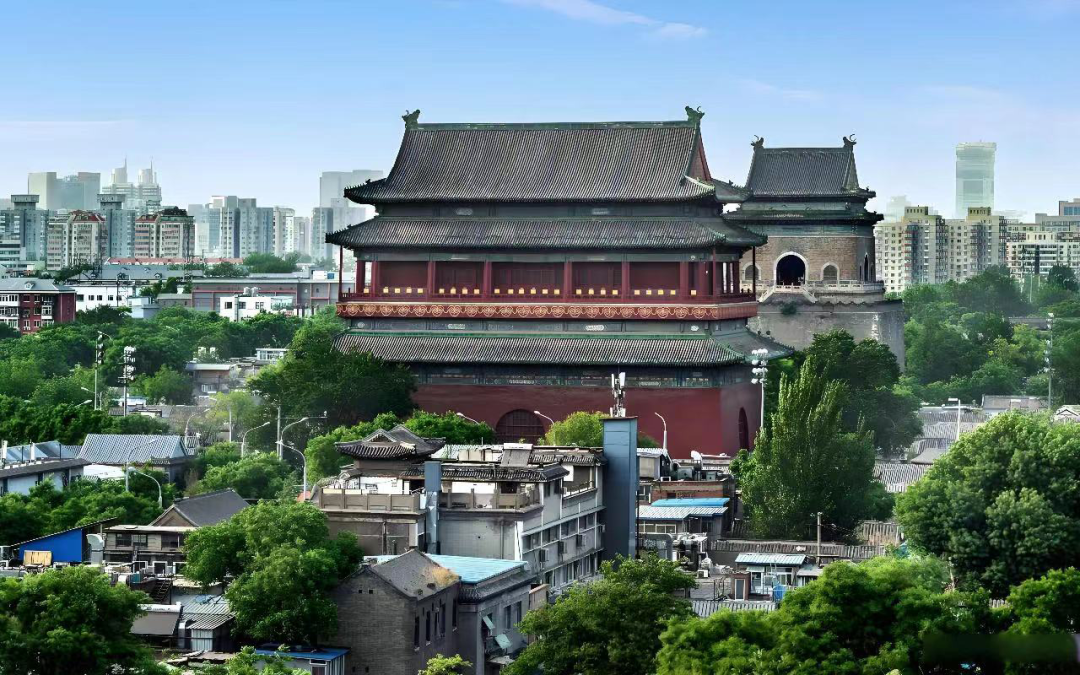
The Bell and Drum Towers are the northernmost landmark buildings on Beijing Central Axis. In the Ming and Qing dynasties, the Bell and Drum Towers undertook the function of urban timekeeping. The Wanning Bridge, one of the oldest bridges on the Central Axis, crosses Di'anmen Outer Street and has witnessed more than 700 years of history and changes.
The next attraction on the Central Axis is Jingshan Park that has been classified as an important part of the imperial palace since the Yuan Dynasty and built according to the imperial palace standards. It was the back garden of the royal family and an important place for emperors to worship ancestors. Climbing to the top of Jingshan Hill, you can overlook and enjoy the panoramic view of the Forbidden City, take a glance at the Central Axis of the capital, and appreciate the rhyme of symmetrical layout and the magnificent palace complex -- the Forbidden City.


As the imperial palace of the Ming and Qing dynasties, the Forbidden City is one of the world's largest and best-preserved ancient wooden buildings, famous for its magnificent scale, rigorous layout, and exquisite architecture. Its positional relationship with Beijing old town reflects the planning concept of "building palace right in the middle" when ancient Chinese capitals were built. The royal court area composed of Tian'anmen Gate, the Upright Gate and the Forbidden City lies on the south side and the Bell and Drum Towers market area on the north side, reflecting the ideal capital city planning paradigm featuring "royal court front and market back" recorded in Kao Gong Ji, an ancient text known as the Book of Diverse Crafts.


Walking through the buildings of the Forbidden City, you can find that the Altar of Land and Grain and the Imperial Ancestral Temple are arranged on the left and right sides of the Beijing Central Axis, reflecting the ideal capital pattern of " Ancestor Left and Land and Grain Right" contained in Kao Gong Ji. The Altar of Land and Grain is the place where the emperors of the Ming and Qing dynasties prayed for good harvest from the land and of the five grains. The altar surface is paved with soil in five colors -- yellow, green, red, white, and black, symbolizing "emperor's possession of all land". The Imperial Ancestral Temple was used to worship the ancestors of the emperors. It is the most complete and largest royal temple complex in China.


Further south, Tian'anmen Square Complex bears witness to the changes in China's modern history and is the main venue for major national events. At the south end of Tiananmen Square, you can see Zhengyangmen Gate which is called "the head of the nine gates". It is composed of two tall buildings -- the Gate Tower and the Archery Tower in the north and the south respectively. It is the largest and highest one among the inner and outer city gates of Beijing.


All the way to the south, you can see the Temple of Heaven and the Altar of the God of Agriculture facing each other. This is the core area of royal sacrifices and ceremonies in the Ming and Qing dynasties. In ancient times, an emperor would worship the God of Agriculture at Altar of the God of Agriculture on Mid-Spring Hai Day, then go to the Temple of Heaven to farm in its own farmland, and finally come to the Yongdingmen Gate which is the most spectacular one among the seven gates in Beijing's outer city and the southernmost landmark building on Beijing Central Axis.


Walking along the Central Axis where history and modernity are intertwined, every step seems to be able to transcend time and space. We can feel the historical vein of Beijing, the charm of the ancient capital, and its profound history and culture. These heritage sites not only have their own characteristics in architectural art, but also show people's pursuit of traditional values and order. Their cultural value is irreplaceable.

The successful inscription of the Beijing Central Axis on the World Heritage List marks another important achievement of China in world cultural heritage protection. It also provides an opportunity for the international display and promotion of Beijing's and even China's traditional culture. With the continuous development of this ancient city, Beijing Central Axis, as a cultural axis connecting the past and the future, is gradually becoming a window for showing Chinese culture and telling the world China's story.


