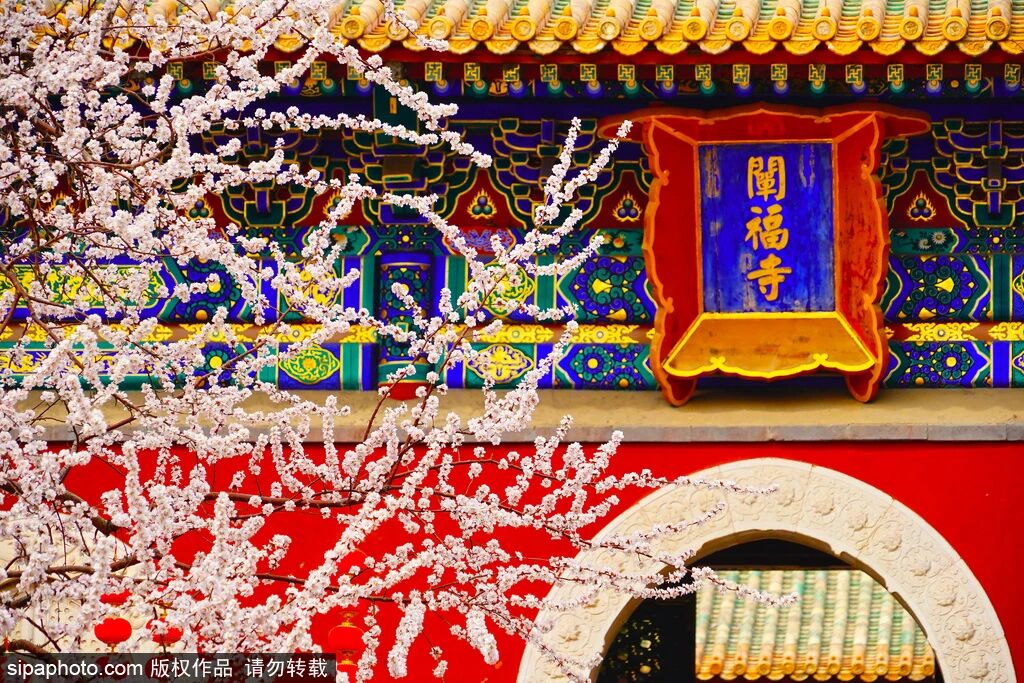
The National Central Axis of Beijing runs from the north at the Bell and Drum Tower to the south at Yongding Gate, with a total length of approximately 7.8 kilometers, traversing the center of Beijing's urban area. Having witnessed more than 700 years of the mundane world, it has always been the soul and lifeline of the city of Beijing. As summer departs and autumn arrives, the most beautiful season of the year is coming to the city. If you want to quickly get to know Beijing, you might as well follow the Central Axis, ride into Beijing's most beautiful season in autumn, and experience the beauty of the ancient capital wholeheartedly.
Beijing Bell and Drum Tower


Beijing Bell and Drum Tower - Serving as the timekeeping center during the Yuan, Ming, and Qing dynasties, it used the deep sounds of bells and drums to announce the standard "Chinese time." The daily rhythms of both officials and ordinary people were based on it, making it a true time architecture.

The bells and drums of the Beijing Bell and Drum Tower chime 108 times to indicate the time. It involves striking rapidly 18 times, then slowly 18 times, followed by another 18 strikes at a moderate pace, alternating between fast and slow rhythms, repeated twice. The ancient Chinese used "108" to represent a year, including 12 months, 24 solar terms, and 72 climates, which together add up to 108. The Beijing Bell and Drum Tower has maintained the timekeeping method of "evening drums and morning bells" throughout over 700 years. "Evening drums and morning bells" should not be literally regarded as "drumming in the evening and ringing in the morning," but rather as a timekeeping practice that begins with "evening drums" and ends with "morning bells".

Water Clock Timekeeping, Drumbeat Timekeeping, and Bell Striking Timekeeping together constitute the complete historical timekeeping system of the Beijing Bell and Drum Tower. They serve as the equivalent of the hour hand, minute hand, and second hand of a clock, each with its own role, working in coordination.
The architectural layout of the Beijing Bell and Drum Tower embodies the profound implification of the Chinese people regarding the "relationship between humans and nature." Its timekeeping system also reflects the Chinese people's keen and intricate perception of time, as well as a comprehensive and systematic descriptive system.
Silver Ingot Bridge


There are three lakes situated at the northwest corner of the Beijing Forbidden City, collectively known as Shichahai ( literally means "the lake of ten temples"), which includes Qianhai, Houhai, and Xihai, in that order from east to west. The history of Shichahai predates the founding of Beijing itself, with records dating back to the Liao and Jin dynasties.

Silver Ingot Bridge is situated on the waterway between Qianhai and Houhai, and it is a north-to-south single-arch stone bridge constructed from alabaster. It serves as an important bridge for the local residents of the Shichahai area to commute, work, and for visitors to leisurely explore and appreciate historical sites.
Historically, the Silver Ingot Bridge can be traced back to the early Ming Dynasty, making it over 500 years old. Even before the Ming Dynasty, a precursor to this bridge existed. During the Liao and Jin dynasties, the water area where it now stands was extensive, and boats could reach Jishuitan. Thus a wooden bridge spanned the water. By the time of the Yuan Dynasty, when the construction of Beijing Great City took place, this area had already boasted numerous boats, and commercial activities thrived on both banks. In the early Ming Dynasty, the wooden bridge took on an elliptical shape resembling an inverted silver ingot, hence the name Silver Ingot Bridge. During the Ming Dynasty, it was rebuilt into a single-arch stone bridge, but the name Silver Ingot Bridge has lasted.

Yinzhuo Bridge is located at the junction of two seas and offers a wide view. Every time the red sun embraces the mountains and the evening sun takes the color away, standing on the bridge and looking to the northwest, the nearby water sparkles, the distant western mountains are hazy, and the beautiful scenery of the mountains and water blends with the city can be caught at the end of your eyes. This is the View of the Silver Ingot Mountain.
Prince Chun's Mansion (The Former Residence of Soong Ching Ling)


Established during the Kangxi era, it was originally the western garden of Nalan Mingzhu's residence. After the passing of Nalan Mingzhu, the estate was seized by Heshen and later bestowed by Emperor Jiaqing to Prince Chengqin (Yongxun). Then it was extensively renovated and reconstructed abiding by the standards of a royal mansion. Thus known as the Prince Chengqin's Mansion. In the 14th year of the Guangxu reign, Prince Chun's Mansion was relocated here, distinguished from the old one and commonly referred to as the Northern Mansion.

Soong Ching-ling moved here in April 1963 and lived, worked, and studied here until her passing on May 29, 1981. In October 1981, it was officially designated by the state as the Residence of Comrade Soong Ching-ling, Honorary Chairwoman of the People's Republic of China. Since May 29 of the following year, it was opened to the public.


Within the garden, there are winding streams, rugged rocks, a variety of flowers and trees, lush grass, and scattered pavilions and halls, all blending harmoniously into a tranquil and elegant courtyard. The main building, a two-story structure with a combination of Chinese and Western architectural elements located to the west, was the residence of Soong Ching-ling (built later) and also served as an office and meeting place. It is referred to as the main hall and contains exhibits in their original state. Between the buildings and the South Lake lies a lawn, and on the southern bank of the South Lake stands a two-story Ming Dynasty building known as the South Hall.
Jingshan Park

Jingshan Park is located at the central point of Beijing's north-south axis, with the Forbidden City to the south, Beihai Park to the west, and the Drum Tower to the north. It was once the highest point in the center of Beijing.
Jingshan Park had been built more than 800 years ago, dating back to the 19th year of the Jin Dynasty's Dading era (1179 AD). In the 18th year of the Ming Dynasty's Yongle era (1420 AD), the soil and debris from demolishing the old imperial city and digging the Tongzi River for the new Forbidden City were piled up on the site of the old Yuan Dynasty building called Spring Belvedere, forming a mound known as Wansui Mountain. In the 12th year of the Qing Dynasty's Shunzhi era (1655 AD), this mountain was renamed Jingshan and underwent significant expansion during the Qianlong era, with all buildings constructed according to imperial palace standards, making it an integral part of the imperial palace.


The Hall of Imperial Longevity in Jingshan Park is the second-largest architectural complex along Beijing's north-south central axis after the Forbidden City. The current Hall of Imperial Longevity complex was built in the 14th year of the Qing Dynasty's Qianlong era (1749 AD), and it was decreed that portraits of deceased emperors and empresses, as well as used items, should be collected in the Hall of Imperial Longevity. Every year on seven important ceremonial occasions such as lunar New Year's Day, Qingming Festival, Frost's Descent, the Festival of The Hungry Ghosts, The Winter Solstice, Longevity Day, and Anniversary of Death, the royal family holds grand ancestral ceremonies at the Hall of Imperial Longevity.


Wanchun Pavilion, located at the highest point of Jingshan, serves as the focal point of Beijing's north-south architectural axis. It is renowned as the commanding point of the central axis of Beijing, offering panoramic views of the capital, making it the first scenic spot along Beijing's central axis.

Watchtowers of the Forbidden City


As a popular tourist attraction, watchtowers are part of the Forbidden City and date back to the Ming Dynasty, boasting a history of 600 years. The designer of the watchtower employed the artistic technique of borrowing scenery in an ingenious way, drawing inspiration from the architectural forms along the river seen in Song Dynasty paintings. They used the rippling waters of the watchtower as a backdrop, with the Forbidden City reflecting in the water, creating a picturesque reflection of reminiscent of an imperial city.

Today, visitors can take a close look at the Southeast and Northeast watchtower. These four watchtowers stand on the ancient city wall with a history spanning six centuries. While the winds may howl and the elements may rage, the watchtowers sit serenely atop their massive stone pedestals, surrounded by stone railings. Their splendid width, depth, altitude, and protruding eaves all convey a sense of fluidity within structure and the idea of large in small, establishing an organic connection between the watchtower and the city walls, two completely different architectural forms. The watchtower sets amidst layers of water, and the craftsmanship is as exquisite as fine jade, which is regarded as a unique architectural masterpiece in the history of world architecture, characterized by their wooden structure with nine beams, eighteen columns, and seventy-two ridge lines."

China Railway Museum

China Railway Museum is a specialized science and technology museum within the Chinese railway system. It serves various museum functions, including collecting, preserving, researching, exhibiting, and disseminating information. Its primary responsibilities include preserving the cultural heritage of the railway industry, promoting railway technology knowledge, publicizing achievements in railway development, and managing the collection, preservation, exhibition, and research of railway historical relics and scientific achievements.

China Railway Museum currently consists of three exhibition halls: the Zhengyang Gate Exhibition Hall, the Dongjiao Exhibition Hall, and the Zhan Tianyou Memorial Hall. The Zhengyang Gate Exhibition Hall is located at the former site of the Zhengyang Gate East Railway Station of the Peking Mukden Railway, southeast of Tian'anmen Square. In 1906, the Zhengyang Gate East Railway Station of the Peking Mukden Railway was constructed and became the largest railway station and transportation hub in the country at that time, witnessing numerous significant historical events in modern Chinese history.


In November 2009, the China Railway Museum integrated with the Beijing Railway Museum to form the new China Railway Museum. The Zhengyang Gate East Railway Station became the Zhengyang Gate Exhibition Hall of the China Railway Museum. Promoting both the tangible and intangible civilization of the Chinese railway, it primarily showcases the historical development of China's railways. It boasts a rich history, splendid achievements, and a bright future for China's railways to the world. The Zhengyangmen Exhibition Hall officially opened on August 1, 2010.
Beijing Tianqiao

Beijing Tianqiao, originally a stone bridge located on the southern section of Beijing's central axis, had long served as a dedicated route for imperial rituals such as the worship of heaven and rain prayers, earning it the name Tianqiao which means heaven bridge. Since the 1920s, it witnessed various transformations, including the conversion of the Longxugou Canal to an underground sewer, the construction of a tramline, and road widening projects. Eventually, in 1934, Beijing Tianqiao was torn down and faded into history ( The site of it is now a heavily traveled intersection).


In 2013, a new arched scenic bridge by bluishwhite jade and two stone steles quietly standed at the south intersection of Beijing Tianqiao South Street and Temple of Heaven Road. The historical and cultural scenic bridge was moved approximately 40 to 50 meters south of the original site to avoid traffic disruption. The scenic bridge and replicated steles together form the Beijing Tianqiao Historical and Cultural Scenic Square.

There is a standalone building with four clock faces on the west side of Beijing Tianqiao South Street along Beijing's central axis, The clock faces were not originally located here but several hundred meters to the west at the intersection of North Latitude Road and Luchang Street. Nowadays, the four-faced clock has been relocated and recreated to revive the resort of the old Beijing Tianqiao. Amidst fountains and green hedges, the present-day four-faced clock and the Eight Weird Sculptures on the north side of the Beijing Tianqiao create a pleasant small square. It has become a beloved spot for both residents and tourists to relax and enjoy leisure time.
Yongding Gate

Yongding Gate, the main gate of the outer city wall of Beijing during the Ming and Qing dynasties, is located at the southernmost end of Beijing's central axis. Yongdingmen was first built in the 32nd year of the Ming Jiajing era (1553), symbolizing eternal stability.

In 2004, Yongding Gate was reconstructed. The stone plaque of the reconstructed Yongding Gate was carved according to the original Ming Dynasty stone plaque. In 2003, the original Ming Dynasty stone plaque of Yongding Gate was discovered beneath an ancient cypress tree at the entrance of the Beijing Ancient Architecture Museum of Beijing's Temple of Agriculture (Xiannongtan). This stone plaque, measuring 2 meters in length, 0.78 meters in height, and 0.28 meters in thickness, features the characters '永定门' in bold and vigorous regular script, and it is exceptionally well-preserved as an original piece from the year 1553 when Yongding Gate was first built. The '永定门' characters on the stone plaque above the gate of the reconstructed Yongding Gate are carved based on this original stone plaque.

Approximately 3 kilometers south of Zhengyang Gate, a broad pedestrian space extends to Yongding Gate. During the Ming and Qing periods, this stretch of road served as the central imperial road for the Emperor's procession to the Temple of Heaven for rituals or to the Temple of Agriculture for plowing ceremonies. In 2019, both sections of this imperial road were restored and reconstructed, allowing seamless pedestrian access along the southern central axis. Walking along the imperial road, you can find it is noticeably different from the asphalt roads on either side, encountering stone slabs underfoot with fine grooves, which symbolize the comes and goes of a long history.