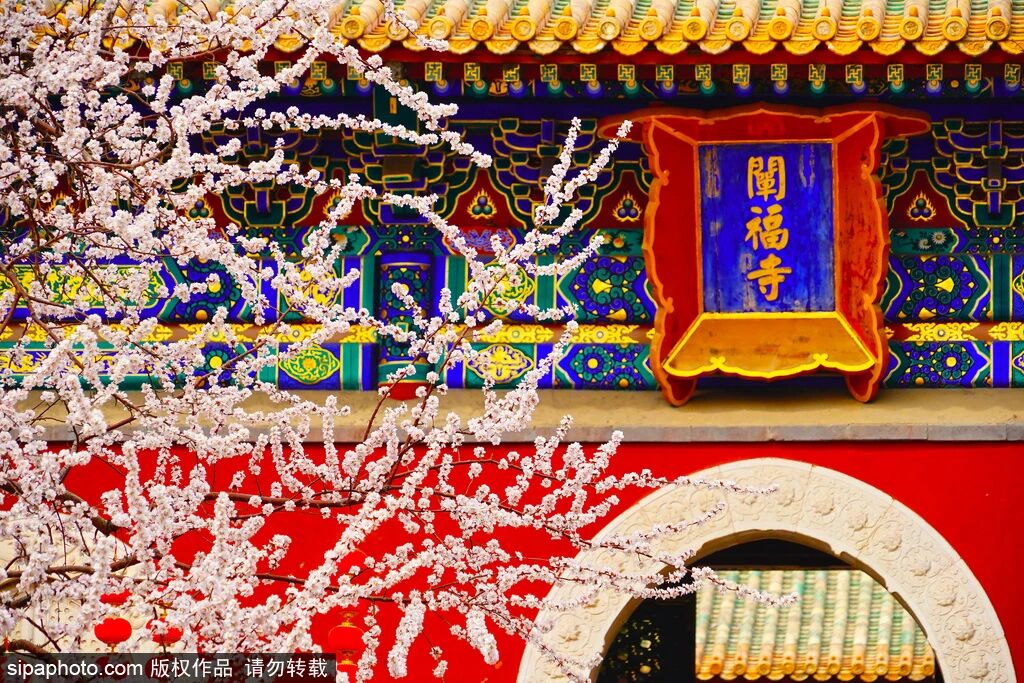
Beijing has a deep blue sky in winter. On a clear day it is customary to bask in the sun and explore the city with a camera. The gingko leaves were falling in the cold wind, the afternoon sun was shining on branches to golden yellow, and vegetation was turning into mild light yellow or green. Red walls, grey tiles and green window frames of the traditional old buildings make a unique beauty for Beijing’s winter.
From Dongsi Hutong to Fuxue Community
The area of Dongsi stretches from Dongsi Station to Zhangzizhong Station (metro stations), with “Dongsi 1st Alley” to “Dongsi 44th Alley” arranged from south to north. In the past, Dongsi is a gathering place for wealthy and influential families. It not only has residences of the Emperor and officials, but also dwelling places of men of literature and writing.
Dongsi has been watching the historic changing of Beijing since the founding from various urban renewals. The part from Dongsi 3rd Alley to Dongsi 8th Alley is still similarly as old, which retain the charm of those years.
Grey walls and tiles as well as red and green window frames are both the unique beauty of courtyard and living imprint of the authentic Beijing. When winter comes, the leaves have fallen out in hutong, and the persimmon tree has stretched its branches out of the wall.
When you look up while walking in a hutong, you may see birdcages belong to the native Beijingers who love to carry a caged bird. Actually, it was originally the hobby of upper class in the Qing Dynasty, and then got popular among common people, acting as a comfort in a busy life. It is said that Beijingers are proud of raising birds and love
birds like life.
You can go towards north, through the metro station of Zhangzizhong Station, to Fuxue Hutong from Dongsi. Compared with Dongsi, the Fuxue Community has a livelier environment. It seems more like the living imprint for daily life: a traditional market it located at the cross with Jianzi Hutong, and even the experienced barber keeps working at the roadside with a chair, an apron and a customer, decade after decade.
Moreover, there is a locally well-known miancha (seasoned millet mush) shop at No. 7, Daxing Hutong. The natives here prefer seasoned millet mush as the breakfast in winter, which grounds a mash made of broomcorn millet flour or millet flour and covers with sesame paste, making people warm and comfortable. This shop, with no signboard but only house number, has been open for 23 years, which raises the price from 0.7 yuan to 4 yuan and provides takeaway only.
Take a circle around the Fuxue Community and then walk out of Zhangzizhong Road. You can see the Mansion of Princess Hejing, Duan Qirui Former Government Building and the Former Residence of Ouyang Yuqian.
Route: Dongsi—Zhangzizhong Road—Fuxue Hutong—Beijianzi Lane—Daxing Hutong—Premier Wen Hutong—Zhangzizhong Road
From Yong’an Li to CBD
Set out from Yong’an Li metro station, one side is the CBD lined with high-rise buildings, while the other has quiet streets and architectures with foreign characteristics behind the Silk Market. Embracing the embassies of all countries here, the embassy district is quiet and occasional people ride by bicycle.
Go to the Ritan Park through the roads of the embassy district, and then keep going all the way east from Guanghua Road to China World Mall, the CBD of Beijing.

The architectures around Ritan Park are classic and magnificent. It feels like going back to the life of the last century, seeing the sparse dead leaves near the red wall and the fallen kite on the tree. On the other hand, the sun is shining on the glass curtain walls of tower buildings belong to China World Mall, attracting people to look up all the time.
Route: Yong’an Li—Ritan Park—Guanghua Road
From Beihai Park to Di’anmen Inner Street

Although the Beihai Park is not available for a boat trip in winter, you can enjoy a different view with sparse green or yellow leaves under the sky and the shadow of the trees reflecting on the red walls of palatial gardens.
Bei Hai has been the imperial “ice play” place since the ancient times. So long as the lake surface is frozen, the Eight Banner youths will hold ice-skating competition and various “ice play” performance for the Empress Dowager Cixi. Now it is a skating rink for common people in Beijing.
In winter, Bei Hai is the gathering place for migrant birds, such as the rare variety, Anas Formosa. The sunset lights and mandarin ducks contrast finely with each other on the lake surface.
If you take an overlook of Jingshan Park at dusk, getting out from Beihai Park and passing through Jingshan West Street and Back Street, there is an unexpected beautiful picture that pavilions, terraces and open halls are sparkling with golden light.
Passing through Jingshan Back Street and Di’anmen Inner Street then walking into the adjacent hutong, a bustling community is set outside the wall of imperial palaces. When the sun goes down, trees of both sides of the road and the sky form a collage of orange and deep blue.
Route: Bei Hai Park—Doushanmen Street—Jingshan Back Street—Di’anmen Inner Street
Winter Scenery of the Summer Palace

You will be pleasantly surprised by the Summer Palace in winter. The West Causeway is covered by reeds, pine and cypress reflect back the palace, deep blue ice is frozen on the lake, and an ink and wash-like scenery is made of the deadwood of willow and the thither pavilion.
The Summer Palace opens Ice rinks, equipped with bicycle on ice, electric ice wagon and other facilities, in Kunming Lake and Suzhou Street, which are the indispensable entertainment for Beijingers in winter.
Golden lights will penetrate through the Seventeen-Arch Bridge on Kunming Lake at sunset, and if we head south to the West Causeway, there are fewer tourists. Dark yellow withered grass, interlaced branches and the lake-surface with scattered ice make different winter scenery of serenity.
Occasionally, some visitors take a walk with dogs, and naughty boys kick the ice block picked from the lake.