There is no better way to explore the old Beijing flavor than to watch the classical play Teahouse. There is no better way to learn about the life of Lao She, its writer, than to pay an extended visit to his former residence.
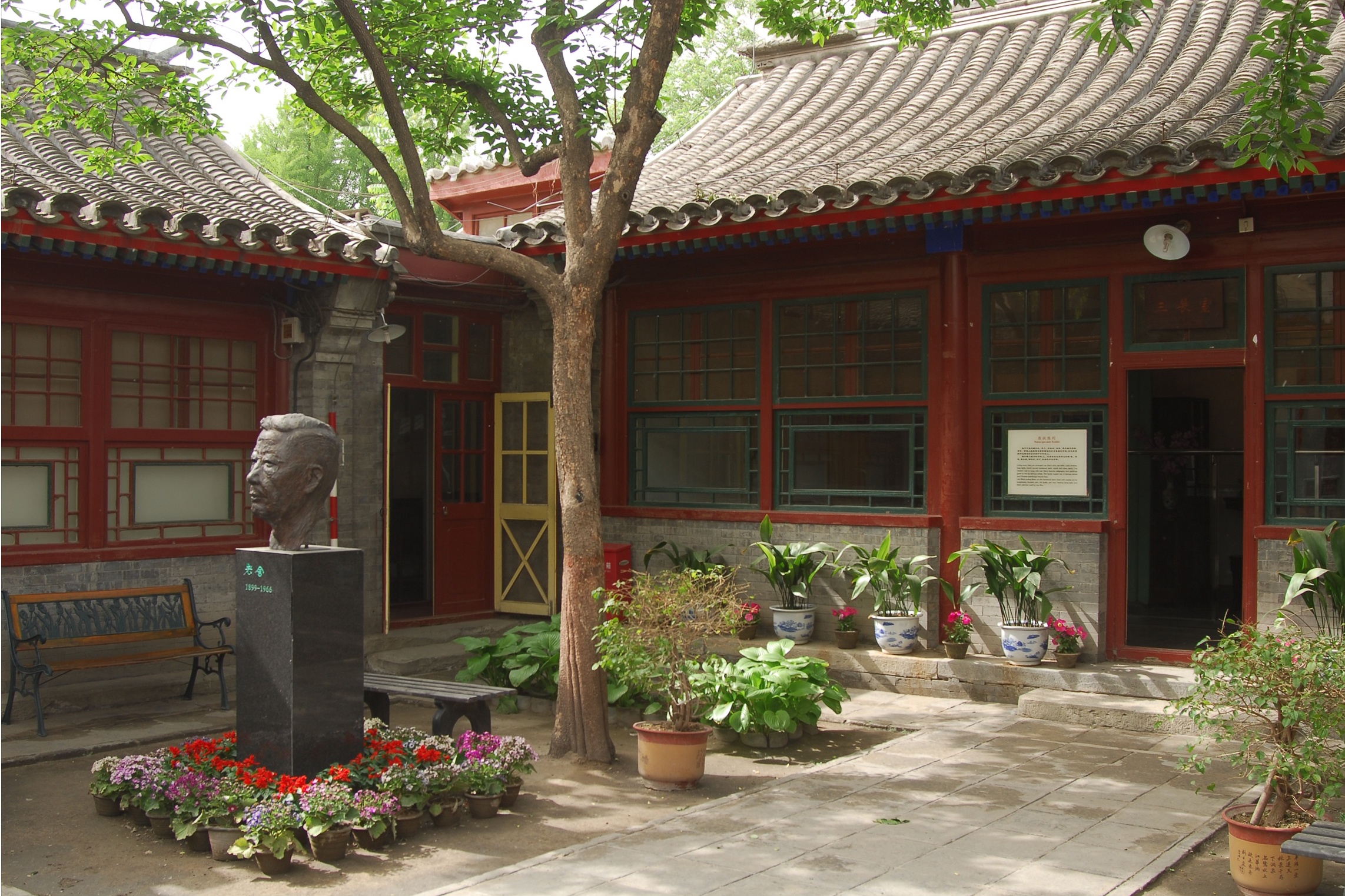
In Beijing's Dongcheng district, not too far from the bustling Tian'anmen Square is a common looking narrow alley, Fengfu Hutong, where hides the former residence of Lao She(1899 - 1966), one of the most significant figures of 20th-century Chinese literature. Shu Qingchun, better known by his penname Lao She, was a Chinese novelist and dramatist, and best known for his novel Rickshaw Boy and the play Teahouse.
The residence is a three-piece quadrangle courtyard, quaint as it is. Lao She spent his 16 most prolific years here and produced 24 novels. He also received many distinguished guests here, including former Chinese premier Zhou Enlai and fellow established writers Ba Jin, Cao Yu and Zhao Shuli.
Stepping across the threshold of the main gate, visitors will come upon a screen with the character Fu, meaning Luck, written by Lao She's wife Hu Jieqing. The house includes a living room and an impressive exhibition of his works including those translated into foreign languages. But perhaps the most tangible example of how he lives on through his deeds is provided by the two persimmon trees planted by Lao She himself in the front yard, which bear plump and mellow fruits each autumn.
The courtyard was open to the public in 1999 on the author's 100th birthday, free of charge. The simplicity of the past was maintained in this quiet yet fascinating construction.
Address: 19 Fengfu Hutong, Dengshikou West Street, Dongcheng District, Beijing
Tel: 010-65599218
Opening Hours: 9:00 - 16:00 (Closed on Monday)
Ticket: Free