
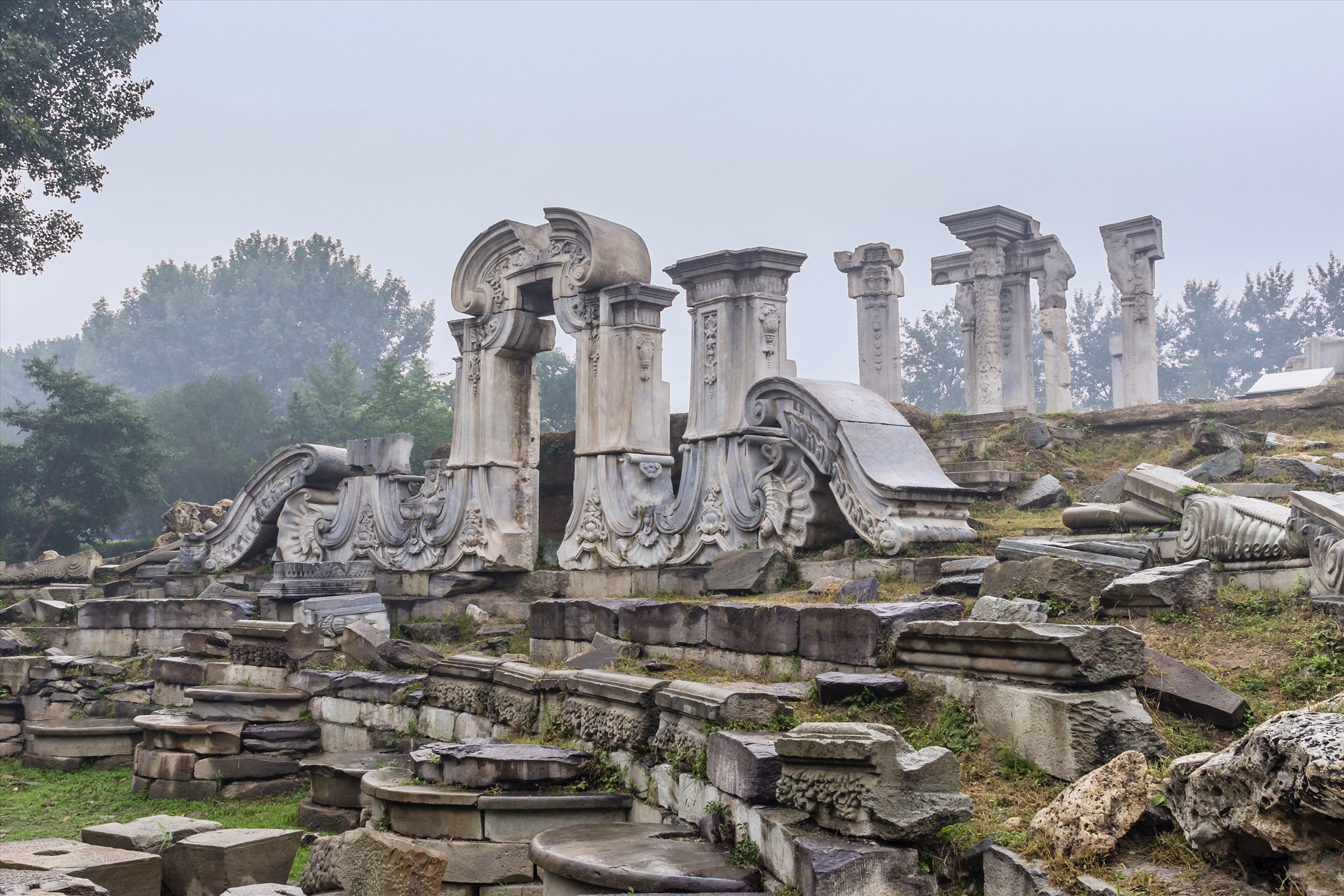
Yuanmingyuan, a resort used by Manchu royalty, was burned down by Anglo-French expedition forces in 1860. Archaeologists are now rediscovering the magnificent landmark.
In China, the destruction of Yuanmingyuan ("the garden of perfect brightness"), or the Old Summer Palace, in Beijing is seen as a national tragedy.
In 1860, Anglo-French expeditionary forces burned down this exquisite resort, used by the Manchu royalty of the Qing Dynasty (1644-1911), during the Second Opium War (1856-60).
But now there are efforts to discover more about the magnificent garden. Archaeologists, with the help of paintings and historical records, are trying to get a better picture of this landmark.
In a project to the east of the Yuanmingyuan ruins, the remains of Ruyuan, an exquisite garden in typical Jiangnan style (which refers to areas in East China on the southern banks of the Yangtze River), was unearthed.
The 19,000 square meter garden is a replica of Zhanyuan, a garden in Nanjing, in eastern Jiangsu province, and it was built following an edict by Emperor Qianlong (1711-99).
The garden, completed in 1767, was called Ruyuan, which means "a garden just like Zhanyuan".
Huge, and almost intact, bases of buildings have been found at the site, as well as a garden with paths paved with colorful stones.
"It was a surprise to find the foundations so well-preserved," says Zhang Zhonghua, an archaeologist from the Beijing Research Institute of Cultural Heritage and leader of the Yuanmingyuan project.
"Only some scattered and broken sections were visible before the excavation."
The excavations also show that there was an artificial lake and special equipment to regulate water flow.
As a result, emperors were able to take a boat on entering the garden to a pier by Yanqing Hall.
Zhang says that when compared with the Forbidden City, which emphasized formal rituals, Yuanmingyuan was a place where emperors could relax.
Also, though houses face southward in traditional Chinese architecture, those in Ruyuan broke the rule, probably to give the emperors a view of the lake from all corners of the garden.


