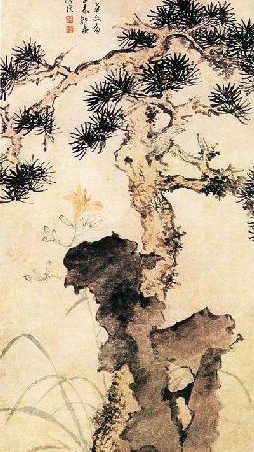
The latter period of the Ming Dynasty (1368-1644) saw the emergence in southern China of two artists best known for their Xie Yi,or free-style, flower-and-bird paintings. They were Xu Wei and Chen Chun. Xu Wei (alias Qingteng) and Chen Chun (alias Baiyangshan) were altogether entitled as Qingteng and Baiyang. Chen Chun (1483-1544) was a native of Suzhou. Chen learned calligraphy and painting from Wen Zhengming, one of the Four Master Painters of Suzhou. Departing later from the Wen style characterized by the use of light, soft brushwork, he took to free sketching and emphasized the mutual permeation of water and ink. Like Xu Wei, he contributed to the development of a free-style method for the creation of ink-and-wash paintings (shuimo hua) and exerted a strong influence over artists of later generations. Chen Chun was good at painting flowers and landscape. In doing landscape paintings, he was strongly influenced by Mi Fu of the Song Dynasty who portrayed ever-changing mist and fog in southern China by using a subtle combination of dense and thin ink black. Chen' representative work in this field is Mount Anhua (anhua shan tu, kept at the Tianjin Art Museum). Luoyang Spring (luoyangchun se tu,kept at the Nanjing Museum) is one of Chen's best free-style painting of flowers.
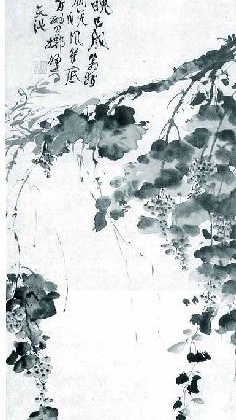
Xu Wei (1521-1593) is also known as Xu Wenchang and, over the last hundreds of years, he has been quite a legend among ordinary Chinese people. Xu was a native of Shanyin (present-day Shaoxing), Zhejiang Province. When he was just 100 days old, Xu lost his father. As he grew up in reduced circumstances, he took part in official examinations time and again in a bid to land a job as an official. He failed in every one of them. In 1557, Xu made friends with Hu Zongxian, military commander of seven provinces in southeast China. Hu held Xu in high esteem for his talent, invited him to do some clerical work and paid him handsomely. This was the best period for Xu. Five years later, however, the military commander was arrested and Xu lost his job and protection. Fear for being implicated drove Xu almost to distraction. He attempted repeatedly to kill himself and later killed his wife by accident and spent seven years in prison for it. After his release, Xu lived by selling his calligraphic works and paintings, and died at the age of 73. Xu Wei's Grapes(mo putao tu, kept at Beijing's Palace Museum) shows his highly accomplished skills in doing free-style(Xie Yi) ink paintings. Poem composition, calligraphy and painting -- all must be good for an accomplished scholar-painter as Xu Wei. Xie Yi, or free-style, flower-and-bird paintings by Xu Wei and Chen Chun became quite fashionable and had a far-reaching significance in Chinese painting history. If previously Gong BiHua (done with fine, delicate brushwork)flower-and-bird paintings in popularity, then after the emergence of Xu and Chen as prominent artists of the time, the Xie Yistyle had absolute dominance. Qingteng and Baiyang set up spiritual examples for the paintings of modern times.