
Speaking of Nanyuan, the Nanyuan Airport will come first into the mind of many. But one rarely connected it to an imperial garden during the period of Yuan, Ming, and Qing dynasties.
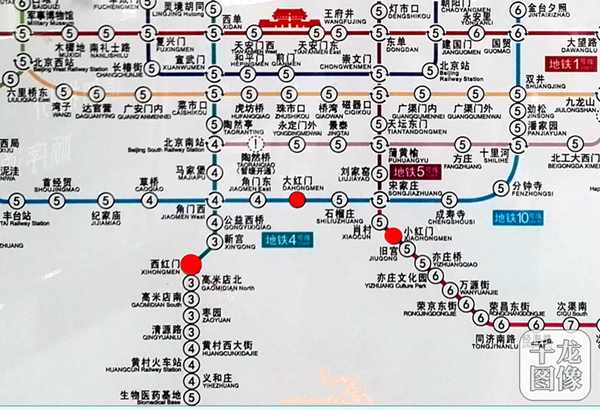
And the garden is the answer why Dahongmen, Xiaohongmen, and Xihongmen are named after the hongmen (red gate in mandarin) in Beijing. The three place names and subway stations are the gates of the imperial garden called “Nanyuan”.
The stations marked in red dots on Beijing Subway Map are Xihongmen(L), Dahongmen(M), and Xiaohongmen(R). [Photo/Qianlong]
Nanyuan’s history
In history, “Nanyuan”, also known as “Nanhaizi”, was an imperial garden during the period of Yuan, Ming, and Qing dynasties.
In Yuan Dynasty, it was an imperial hunting ground, called “Xiama Feifang Po”. “Xiama” means reaching a place near the city by riding a horse for a while, “Feifang” refers to releasing eagles and dogs, while “Po” refers to “Haizi”, called by ancient people to define a large area of water.
In Ming Dynasty the hunting ground was expanded dozens of times, and its name was changed to “Nanhaizi”. An about 60-kilometer-long wall of earth was built surrounding the hunting ground and four gates were set up including Beihongmen, Nanhongmen, Xihongmen, and Donghongmen.
Then in Qing Dynasty, the hunting ground was designated as an imperial garden and renamed as “Nanyuan” for its location in the southern city. During the reign of Emperor Qianlong, the earth wall was renovated into the brick wall and five gates were added to the four gates. Totally the nine gates consisted of each two in the north, east, west, and three in the south, respectively Dahongmen and Xiaohongmen in the north, Donghongmen and Shuangqiaomen in the east, Xihongmen and Zhenguosimen in the west, as well as Nanhongmen, Huichengmen, and Huangcunmen in the south.
Dahongmen
Dahongmen originally refers to the Beihongmen, the front door of the imperial garden “Nanyuan”.
The city of Beijing faces south, with Zhengyangmen (commonly known as Qianmen) being the front door, while “Nanyuan”, the imperial garden, faces north, with Beihongmen (now known as Dahongmen) being the front door. During the period of Ming and Qing dynasties, Dahongmen was an important gate of Nanyuan because it was a must for emperors to pass through and rest in if they went to Nanyuan.
Today, the Dahongmen region, belonging to Fengtai District, Beijing, has gradually become the places assembled with the people from other provinces especially Zhejiang. The region, once called “Zhejiang Village”, has formed a clothing-oriented economic development model.
Xiaohongmen
Xiaohongmen is one of the five gates added in the east of Beihongmen, the front door of “Nanyuan” during the reign of Emperor Qianlong in Qing Dynasty. Therefore, later Beihongmen was called Beidahongmen, now Dahongmen, while the added gate in the east of Beihongmen was called Xiaohongmen.
Now the Xiaohongmen region, located in the southwest of Chaoyang District, Beijing, is a township-level administrative region.
Xihongmen
Xihongmen is named after the west gate of “Nanhaizi” in Ming Dynasty.
The village in Xihongmen can be traced back to the Tang Dynasty with 1,000 years of history. The village called “Xiqili Village” came into being during the period of Liao and Jin. In Yuan Dynasty, an imperial hunting ground called “Xiama Feifang Po” was built to the east of the village. Later in Ming Dynasty, a large number of migrant workers came to settle in the village to construct the hunting ground which was renamed as “Nanhaizi”. The village grew bigger and was renamed as “Qianhutun”. Then during the reign of Emperor Kangxi in Qing Dynasty, the village’s name “Qianhutun” was discarded and many mail houses with the name of “Xihongmen” were set up in the village, which then gradually developed into an important township in the south of Beijing city.
Today, Xihongmen Township, located in the north of Daxing District, is the south gate of Beijing, and its strategic location makes it an important transportation hub in southern Beijing.
Source: english.qianlong.com


