
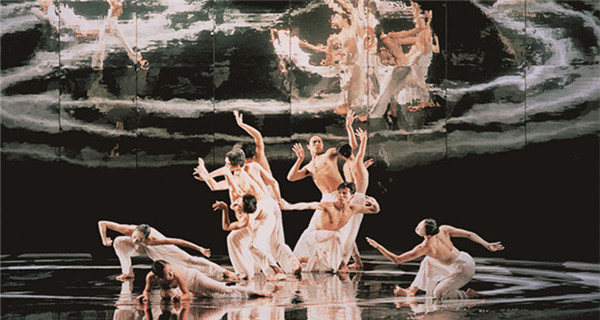
The choreographer Lin Hwai-min creates a poetic rendering of the Taoist philosophy. It is a study of the real vs. the unreal, effort vs. effortlessness, Yin and Yang, and in the end, a study of time.
Topped the list of the best dances in 2003, selected by the chief critic Anna Kisselgoff of The New York Times, Moon Water has been presented by festivals and venues all over the world, receiving rave acclaims since its premiere in 1998.
To the Chinese, Moon Water, or Shui Yuei in Chinese, is a metaphor of two things. One is a Buddhist proverb: “Flowers in a mirror and moon on the water are both illusory.” The other describes the ideal state of Tai Chi practitioners: “Energy flows as water, while the spirit shines as the moon.”Moon Water owes its movement motives to Tai Chi Tao Yin, a Chi Kung exercise that can be traced back to more than 2000 years ago.
The most surprising element of Moon Water is its choice of music. Lin Hwai-min syncretizes this contemporary work to J. S. Bach's Six Suites for Solo Cello recorded by Russian cellist Mischa Maisky. The dancers, describes The Times, “rather than merely duplicating Bach’s tempi and tones, they reach inside his music from the core of their own bodies.” Ballet International marvels that “Bach’s cello suites and LIN Hwai-min’s Tai Chi blend together as if they had waited for each other for hundreds of years.”
Source: chncpa.org


