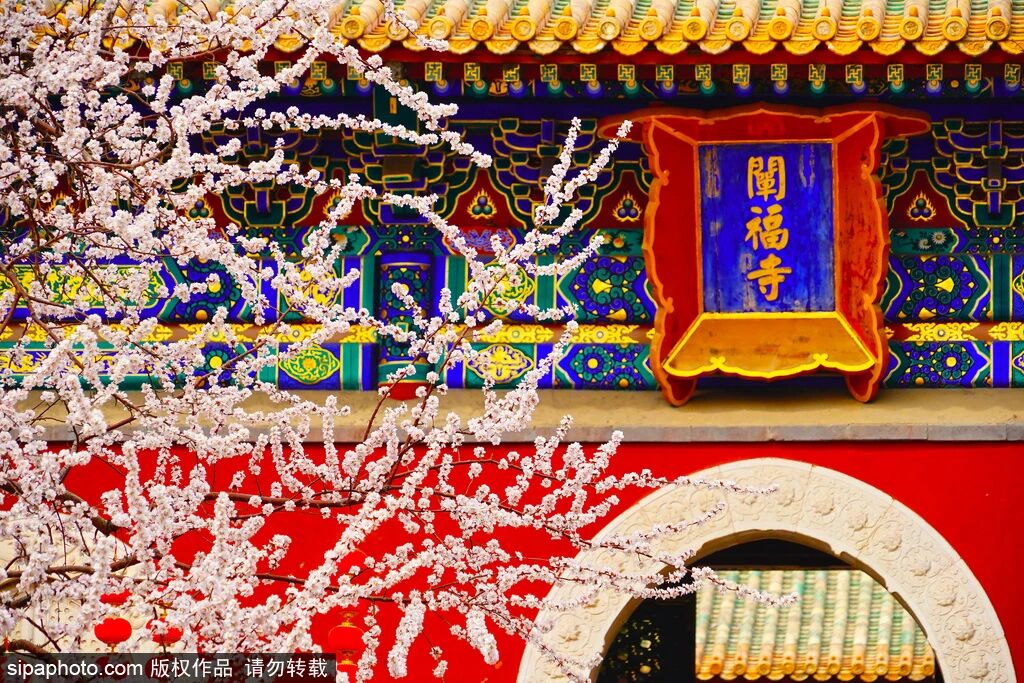
At the northeast corner of Beijing city center travelers will find an elegant and ancient temple known as the Yonghe Lamasery (also named Lama Temple), which is the largest and most perfectly preserved lamasery in present day China.
Built initially in 1694 during the Qing Dynasty, this building was the residence of Emperor Yongzheng when he was just a prince. However, in 1744 the Qing Dynasty formally changed the status of the dwelling to that of a lamasery, and so Yonghe Lamasery became the national center of Lama Administration.
The following details describe the main buildings inside the Lamasery.
On arrival at the south end of the Yonghe Lamasery, visitors will enter a yard which contains a screen wall and three Paifangs (Gateways), and will observe the red walls and stone lions, symbols which show that this Lamasery was originally the dwelling of an Imperial Family member. Entering north from the Gateways, visitors will be confronted by a wide straight road which was used for the carriages of the emperors and their wives during the Qing Dynasty (1644 - 1911). At the northern end of this road is Zhaotaimen (Gate of Peace Declaration), which comprises of three large archways, the central one of which was for the exclusive use of the emperors.

Passing through Zhaotai Gate the visitor will enter the second yard which contains a Drum Tower on the western side and a Bell tower on the eastern side, and in front of these towers are two octagonal Stele Pavilions. Words by Emperor Qianlong were carved in the stele explaining the traditional and historical reasons why dwellings formerly used by Imperial Family members must later be changed to temples.
Yonghe Gate, originally the main entrance to the Lamasery is now called Devaraja Hall (Hall of the Heavenly Kings), as there are the statues of four very powerful Heavenly Kings located on both sides of the inner palace walls. The northern Heavenly King on the eastern side holds a snake and treasures; the southern King on the eastern side holds an umbrella and a silver mouse; and the southern one on the western side holds a sword while the northern one on the western side holds a Pipa (a musical instrument used in ancient China). Located in the center of the Palace is a smiling Maitreya.